Showing posts with label astronomy. Show all posts

Monday, December 14, 2020

Guest Blog by Mxyl: Fact Checking the Future Part 2 - The Great Outdoors and Beyond!

Left: A prediction of 2020 space hotels. Right: A 2020 ad for an Internet-connected "Smart plug."
Fig 1. Our priorities, apparently.

 It's been a bit, but we're heading on a field trip from the virtual home of 2020 to the book's other predictions, some specific to this year and some beyond! Without further ado, let's get to the elephant in the room:

Population: We're actually pretty much on track for the book's population numbers (hard to say as it doesn't give numbers for our specific year), although while different articles disagree on the topic, its overpopulation worries feel pretty dated. Many suspect that what's starting in Japan now is liable to happen in other areas (decreasing but eventually stabilizing), to say nothing of moon bases and whatever other projects lie in store.

Anyway, with that out of the way, it's time for the fun parts:

Space Hotels: "By the year 2020, there will be space hotels as well as space stations orbiting the Earth, 280 miles [up]... A special shuttle service will carry guests to and from Earth as well as on sightseeing tours to the Moon (p.23)... In the 21st century, there will be bases on the moon, probably with lunar hotels (p.56).

...Did Elon Musk just read the same book I did and get incredibly disappointed that we're not there yet? Because it feels like that's what he's going for

Miniaturization: The book shows off that computers have gotten small enough to fit into one's hand... like the Psion Series 3c, complete with its 1 megabyte of RAM. (For what it's worth, given another 20 years an iPhone 8's ~2,000 megabytes of RAM will probably sound just as laughable.) However, we're not here to measure the late '90s, just what it thinks the future will be! They propose an Internet-connected laptop successor, an "Office on the Arm" (a 1996 prototype shown at a wearable machines exhibition) that works as a phone, calculator and alarm clock, complete with a laptop-style touch pad! Again, though, this is one of those instances where the future's out-performed the past's predictions: we can do all that and more from an Apple Watch. Still, the concept of charging it via "a special vest worn by the user, which will convert body heat into energy" still isn't in mainstream use to my knowledge.

Virtual Reality Advancements: Granted, I referenced that this came true in the last post, and it isn't really outdoors-y, but I'll just say it's simulated outdoors. Anyway, the book also mentions "virtual sensory suits" that essentially mimic the feeling of, for instance, a ride or a sport. The Teslasuit does exactly this, bringing "full body haptic feedback" and climate control to the table, while also allowing the potential for motion capture and biometrics, making it a scientific and health tool as well as a media/gaming device. Can't find a price on it, but I'm getting the impression that developer kits are being sold for around $13,000. Well, at least it's nice to know the technology exists. It's worth noting that we're still fairly into the broad "21st century" listed in the book's description, so this could definitely become commonplace within the next eighty years. 

Nonetheless, it's interesting to note that Augmented Reality didn't seem to exist as a concept by this point. I suppose it makes sense--if one's working on technology to enter a virtual world, why would it occur to people to go for only part-virtual?

In-Car Navigation: According to the book, all-new cars will use CD-ROM maps and things called global positioning satellites to calculate the best route to take, complete with a digital voice. This is another one of the cases in which we've out-performed predictions, with zero need for CD-ROMs for maps, to say nothing of phone-based GPS systems. 

Automatic Cars and Highways: Honestly, this is probably one of the more exciting items in that we're right on the cusp on it. Automatic cars have been a thing for a while, but are only starting to enter the mainstream market--mostly in the limited form of cars that, say, guide parking work and keep drivers from drifting outside their lane (I once had the opportunity to travel in one). Whether highways will be electrified or magnetized to keep such cars in their lanes is another question; we seem to have moved past the need for that, relying more on AI recognition technology. 

Calendar of the Future: The book's listed a long-term calendar (up to 2035); there's way too much there to cover in total, but here are its predictions on 2020 (be warned, though--it places electronic shopping as becoming dominant quite accurately in 2014, but it puts the first human landing on Mars at the same year):

Interestingly, in their Could Happen at Any Time segment, they list "worldwide epidemic" right between "human mutation" and "time travel invented." Huh.

Last but not least: some relevant factoids from the book's Fascinating Facts page! 

  • Scientists aim for plastic made from plants: Plant-based plastic has actually come true!
  • The James Webb Space Telescope will turn its eye to galaxies' birth, launching 2011: Well... they were actually off by a bit. Like, ten years. The plan's still around, but according to the Space Telescope's Official NASA Website, the latest delay, due to a guessable health concern, has pushed the launch back to Halloween of 2021. 
  • By 2020, four out of ten people could be working from home: Huh. I guess we've noticed a good chunk of that. What is it with the weirdly relevant stuff?
  • The first manned Mars mission will be in 2019: Missed by a mile... which, since Mars is so far away, actually adds up to a whole lot. (And yes, it did mention it'd be 2014 elsewhere; maybe an update went uncaught in the revision?) On the other hand, Elon Musk (who I'm now all but convinced has read the same book I have) is aiming for the book to only be off by a mere four years

Overall, it's pretty easy to laugh at what they've gotten wrong, but some of its predictions are stunningly accurate. I suppose it shows the difference between an educated guess and a wild, out-in-the-dark one--you can still be wrong with either one, but knowing the data from the past and present allows one to extrapolating something far closer to the truth than going from nothing.

Monday, September 10, 2018

Fun With Astronomy

So far this class is as much fun as I had hoped!

I have 8 high schoolers and I am cramming stuff into every minute of our two hour classes, so I haven't been able to take many pictures.


Our first class was on star gazing.  That's usually done last in most Astronomy classes, but I feel that looking up with wonder is how kids start Astronomy in real life.

It helped that we were able to go to the University of Maryland's observatory, attend a talk by an actual astronomer, get a tour, and look through their telescopes the day after the star gazing class!

We also used a celestial globe and made planispheres (adjustable star charts).

I've used planispheres, but this was my first time using a celestial globe, and it's amazing!  I had a hard time wrapping my head around it at first because all the models I've ever used were showing me how things actually are: the celestial globe shows how things look from Earth.  The little yellow ball is the sun, not the moon: remember that the sun and the moon are the same apparent size from Earth.

You wouldn't think"how things look" would be very useful, but I finally gut level understand what is happening at the equinox!  I mean, I knew that was when the ecliptic crossed the celestial equator, but I didn't really "get" it until I saw it on the celestial globe.  Also, it really is the easiest way to demonstrate seasons and the zodiac, humanity's first calendar (no astrology here!).

The next class was on actual stars and we did a more detailed space time model to explore gravity wells, and we did a fair bit with spectroscopes and special candles with colored flames. Lots of star cycle stuff and lots of stuff on black holes.

I've always enjoyed doing the Kids' Astronomy classes, but it's been really fun to go into it with more depth.  And the questions these kids have!  I just love it!

Today we are off to visit the planetarium down at the Air and Space Museum - hopefully I'll have pictures up on Wednesday.

Thursday, November 17, 2016

Moon Walk

I don't mean this kind of moon walk.


Or this kind:


I mean the kind when the moon comes up and Oob urgently requests a walk to admire it.

We really enjoyed the "super moon" this week- it made for an epic moon walk as we went through the neighborhood, trying to find a tree free space so that we could watch it come over the horizon.

Here it is caught between the lower branches of a tree near our house.

I hope you got to see it, too!

Tuesday, September 16, 2014

Air and Space

 September really is the time to hit the big Smithsonian museums without the crowds.  Last week we went to Air and Space, something we skipped last year.

We had to touch the moon rock, of course!

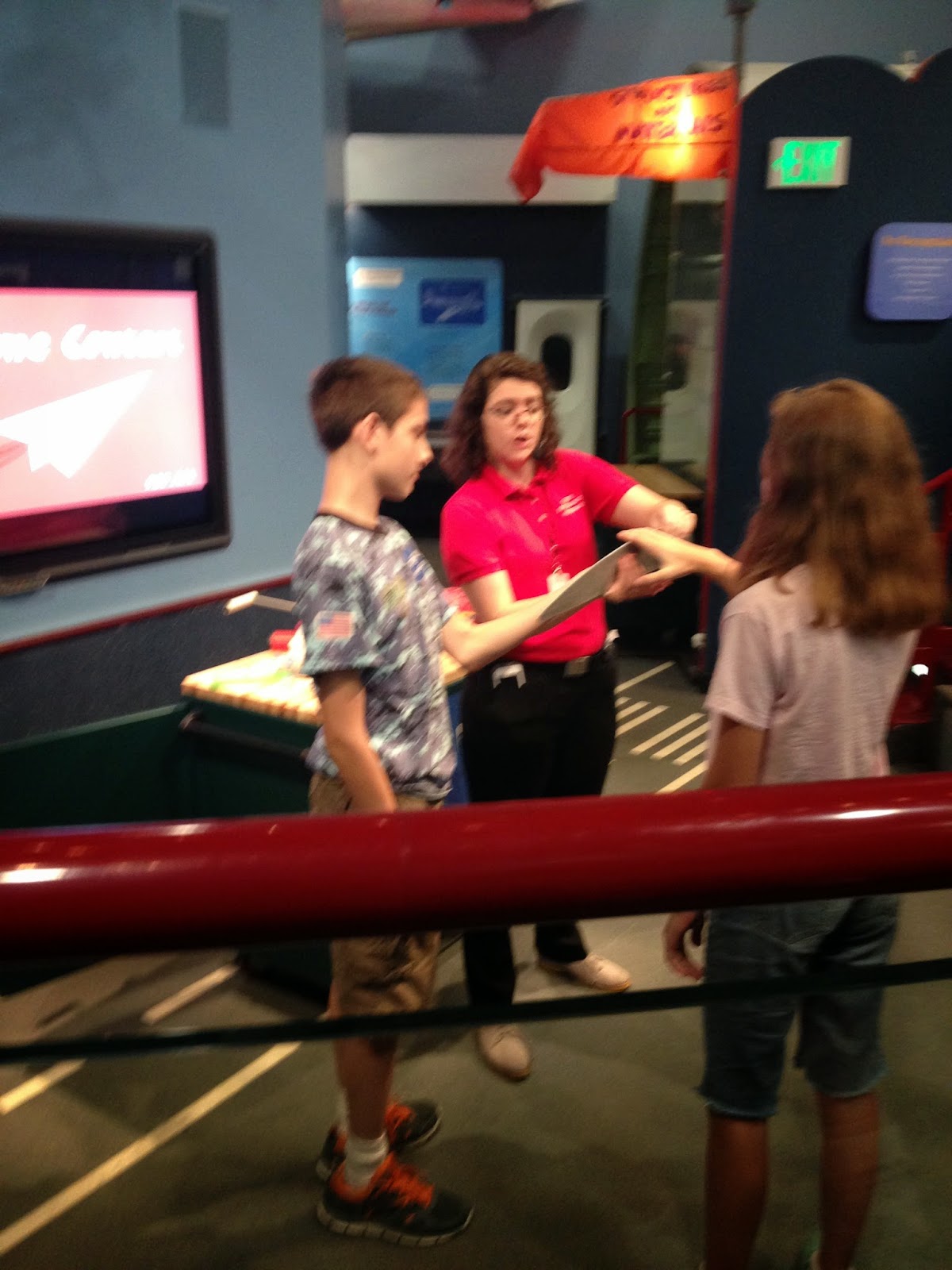
And we always love their hands on demonstrations of the principles of flight.

Here Zorg and Leena are helping to demonstrate how the airfoil shape helps provide lift.


 And we had fun in their little Cessna.


Actually, we had a LOT of fun in their Cessna.

It's one of the few times we've been there where there wasn't a line waiting for turns.


We did some space stuff, too.  We went through the Skylab at least twice (some of us more). 

Klenda, Zorg and Leena found a docent with parts of real space suits who enjoyed chatting with them about how everything worked.

One of the nice things about being home schooled is that you can be interested and ask questions.  My experience in school was pretty different.

All the docent/reenactors/museum people I've seen love to talk to people who are genuinely interested, and, since there weren't many people around, the Zoomlians got to ask as many questions as they wanted.

They left the docent with a big smile!

We also saw the new (to us) exhibit on navigation.  They started with sextants, and went up through GPS - it was a fascinating exhibit!

Friday, May 30, 2014

Seven Quick Takes: Great Book Combos, Cake Fails, and Shark Teeth


 1.  My friend Bill pointed out that you rarely see The Agony and the Ecstasy and Electronics for the Evil Genius on the same shelf.  I suppose he's right. 

I feel like there's something about this book shelf that encapsulates my life.


Big Enough
2 .  I am always on the look out for spots with poor drainage so that when we get a few days of rain we can have a Ducky Day.

This involves putting on rubber boots and hunting down the biggest puddle we can find... After a thorough soaking, we head home for baths, popcorn and hot chocolate!

We started this when Mxyl and Klenda were toddlers, but if you get a big enough puddle, everyone still wants to play!


3. Joy!  Rapturous delight!  This year I used my birthday money to buy a tree peony!  This is a long term investment, but, over the next 50 or so years this graceful plant will get about 6 feet high and 8 feet wide with progressively larger flowers.

This year I get three blossoms this size (8 inches of petals that look like they are cut from iridescent purple silk).
 4. Have you ever made something you were sure was going to be wonderful, and right about the time you are finishing, you suddenly realize...

That it's a terrifyingly creepy dinosaur cake that looks like it's planning to eat your head?

Yeah.  I know. We all go through that.

Fortunately the cake was for Choclo, and he declared it his favorite cake ever.
Trekking to the beach at Purse Park
 5.  It's shark tooth season!  We live in Maryland, in a spot that was covered with a shark infested sea (30 million years ago).  Yes, some people probably would try not to think about that too much.  But we find this wonderful: since each shark has thousands of teeth throughout it's life, our soil is embedded with millions of fossil teeth!

From Bayfront Beach
Fortunately, we don't have to dig for them.  They are continually washed out of the soil and found on the banks of rivers and the Chesapeake Bay.

Which means, on pleasant spring days, we spend the day at the beachplaying in the sand and enjoying the water collecting fossils.

These are teeth, ray plates, and bone fragments (from whales and dolphins) from our latest day off scientific expedition.

If you're wondering why this is seasonal, I have two words for you: jelly and fish.


6. We finished our model rockets this week! We will meet one more time on Sunday to launch at NASA Goddard (I really do love saying that!) and we are done with our Astronomy and Rocket classes.  Hooray!  So fun!


7. If you are wondering what happened to The Big Trip, we are still traveling in Japan, although we will be leaving soon for Mongolia.  Blog posts coming soon, I promise.  We just got snowed under with birthdays, anniversaries, and end of year craziness.

If you are wondering what the heck that's about, the short answer is that we came across a truly enormous pile of imaginary money, and we have been using it to take a once in a life time trip around the world.  You're free to join us, and/or if you live someplace we will, or should be going, to have us "stay" with you!

Happy weekend!  More fun with Jen!

Tuesday, April 29, 2014

Kid's Astronomy: Sun Part 3

I almost forgot!


Or, if you prefer to be more precise:


Although, to be honest, since plasma is just an ionized gas (gas with the electrons stripped away), I prefer the first song. Mostly because it's catchier.
Saturday, April 26, 2014

Kids' Astronomy: The Sun and Other Stars, Part 2

We left off with the life cycle of our middle sized star, Sol.  But what if Sol had been a large star?

For one thing, we wouldn't be here.  If you have a really massive star, planets in the "Goldilocks zone" (where you have liquid water) tend to get tidally locked so that one side of the planet always faces the sun.

For another, massive stars (with their massive gravity), squish hydrogen much faster, so they live less long. They live brighter and hotter, but shorter lives.

Incidentally, the color of the stars is directly related to their temperature.  What do you think the
blue where it's hottest
hottest color is?  Most of the kids thought, "red hot," but if you look at a candle flame, you can see this is not so.   The outermost (coolest) edge of the flame is red, the innermost (hottest) heart of the flame is blue.

And so it is with stars: the coolest stars are red - only about 3000 degrees.  Medium hot stars (like the sun) are yellow, about 6000 degrees.  The really hot stars are blue and white, and they can be 30,000 degrees!  These are all surface temperatures, of course.  The core of the star, where the fusion takes place, is much hotter.  Our sun had a core temperature of 14 million degrees!

Back to those massive stars, after their hydrogen is helium and their helium is carbon and oxygen, they can go right on squishing!  Carbon and oxygen become neon, which gets squished into magnesium, then silicon, then iron.  Then the star can't "squish" anymore.  It explodes into a supernova!

The explosion tosses off gas and dust into an interstellar nebula... Which then begins to condense into new stars.

Meanwhile, what is left of the star becomes either a neutron star or a black hole!

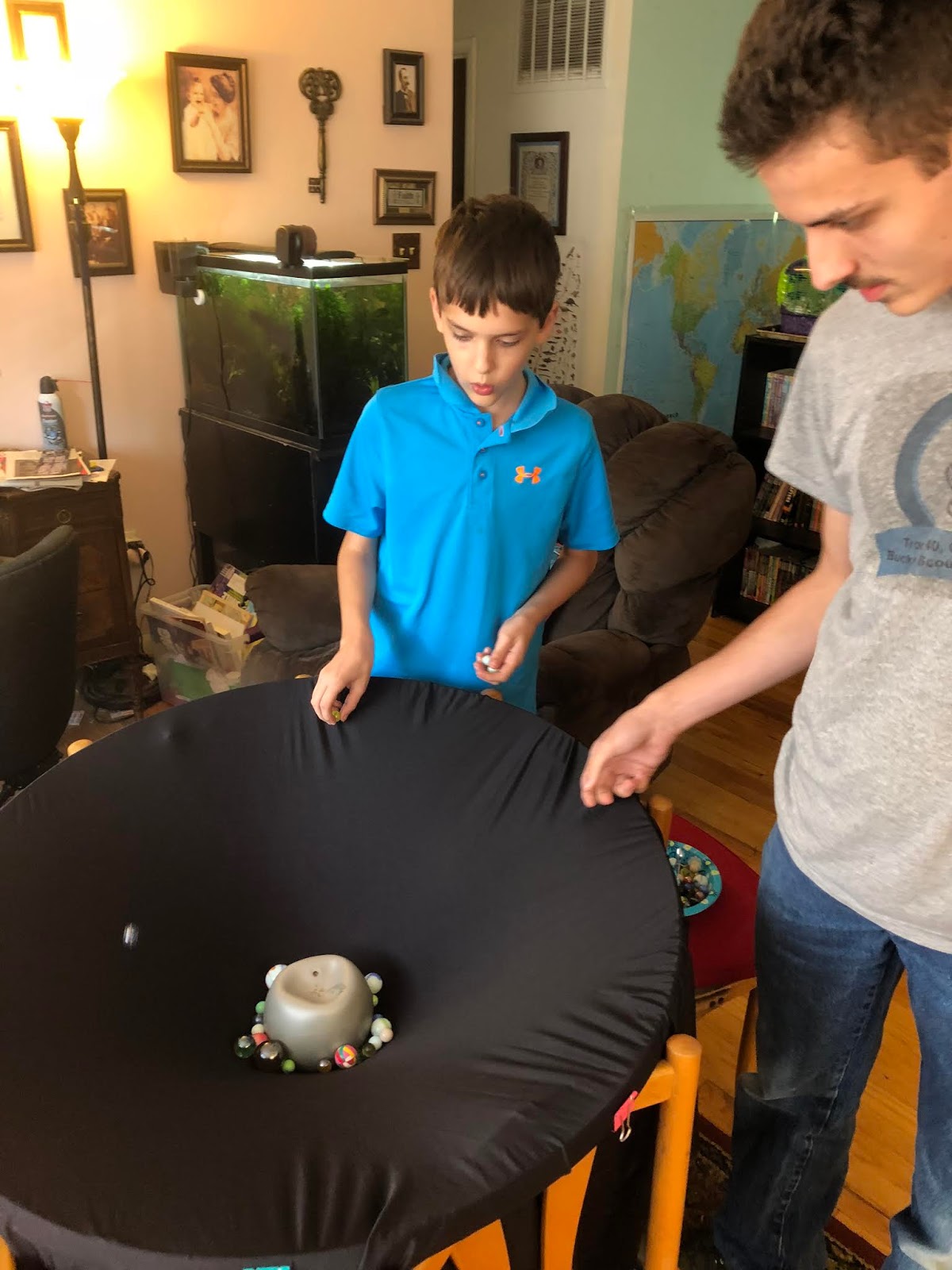
I don't know if you've see the wonderful You Tube going around about gravity/ black hole models, but I really wanted one!  The best I could do on my budget was to put the stretchiest material I could find over a hula hoop.  It's gathered fairly loosely with a rubber band under the hoop.

A small mass (a marble) dented the material in the same way that a small object (like a moon or a planet) bends space around itself.  A large mass, like the rock (or star), bent the fabric enough that the smaller mass would orbit around it!

So.  We have all these stars, in all these stages of the star cycle, scattered throughout the universe and clumped into galaxies.  Most of them are millions of light years away, so how do we study them?

We study their light!  With things we want to study here on earth, we put them under a microscope to see their parts.  With light from space, we use a telescope with a spectrometer.  Believe it or not, building four working spectrometers was in the budget!

You take a paper towel roll and cut a slit near one end at a 45 degree angle.  That slit is where you will put an old CD, or part of a CD (I cut mine into fourths to make four instruments).  The CD is going to spread out your light into a spectrum.  You also need to cut a rectangular viewing hole above the CD so that you can see that spectrum.

On the other side of the roll, cover the open end with foil.  Cut a slit in the foil so that it lines up with the CD.  That slit will allow a narrow beam of light into the tube and onto the CD, the CD will spread the light by wavelength, and you will view a column of separated light through the viewing hole on the top.  More detailed instructions here (HT: Aurora Lipper)

Solar spectrum from a professional!
You point the slit at the light source you are interested in.  We looked at a number of florescent lights first, because these lights only emit certain wavelengths, so you get bright bands of widely separated colors.  We looked at warm tone, cool tone, yellow, and "black" florescents, as well as an incandescent bulb (which gives a much fuller spectrum) and then, of course the sun!

Amazingly, even our home made spectrometers, we were able to see the black lines in the sun's spectrum!   These lines are the elements in the sun itself that absorb certain wavelengths of light.  Each star has a pattern of these lines which tell us exactly what it is made of!

We finished up with a brief discussion of constellations.  I showed them some flashlight constellations (you put foil over the flashlight, prick the pattern of holes in it, then shine it on the ceiling), how to use a star chart, and lastly, the constellation illusion.

Not so lined up!
Essentially, the only place the constellations exist is on earth.  At other points in the universe, the stars just don't line up that way.  I used my lab assistants as the stars and had them line up as a straight line "constellation."  This is how the constellations look to us: as if the stars are lined up at the same distance.

Then I moved my assistants so that they were at varying distances.  From one spot, they still looked like they were all in a straight line, but from every other vantage, they were in a different pattern.


Friday, April 25, 2014

Kid's Astronomy: The Sun and Other Stars Part 1


 We all know that the closest star is the sun, but what is the sun's name?  It's Sol, as in the solar system!

What does our star do for us?  It provides most of the energy on the earth!  Heat and light are obvious, of course, as is solar energy, but really, almost everything is solar energy.


The energy our bodies use to stay alive comes from the sun via plants (and the animals that eat plants).

The energy in the gas that powers our cars comes from ancient plants, and so does the coal that powers our electric plants.

Even wind energy comes mostly from the heat from the sun causing changes in our atmosphere.  Really, only nuclear energy and geothermal energy create energy that does not come from the sun - even tides are partially caused by the sun!

But where does the sun get it's energy?  To answer that, we had to look at how stars are formed.  I used the kid model.

We started out with kids scattered across the yard the way dust and gas are scattered in a nebula.  As the kids moved around, whenever they touched, they stuck together.  As the clump of kids got bigger, they were able to pull more and more kids in.

To no one's surprise, as the mass of kids got larger and larger, the kids in the middle started getting more and more squished.  I took two little girls of equal size and squished them together until.. POOF!  They turned into Mxyl!!  (OK, actually, they ducked out of the way and a previously unnoticed Mxyl popped up in the huddle).

This is very much like hydrogen getting squished into helium: it not only changes size, it changes it's characteristics into a whole new element!  The interesting thing is that the mass of the girls did not equal the mass of Mxyl: where did the extra mass go?

Sure, everyone knows it now.
You've heard of  e=mc2, right?  That extra tiny bit of mass is released as energy.  Energy that is equal to that tiny mass, times the speed of light squared.  Everyone knows that.

Except most people don't realize that when you square the speed of light, that number is fantastically high - like 35 billion!  A little mass makes a lot of energy!

And the sun actually converts 4 million tons of it's own mass into energy every second!


We only receive a tiny fraction of that energy here on earth, of course.  And we don't have to worry about the sun losing too much mass, either.
 We are in the sun's main sequence, the main part of a star's life which it spends fusing hydrogen into helium.  The sun has been doing this for 4.5 billion years, and is expected to continue for another 5.4 billion years.

After that, the hydrogen will be used up, and the sun will fuse helium into carbon and oxygen.  I asked the older kids: carbon and oxygen, where have we heard that before?

Us!  We're made out of stars!  Yep.

Now the sun, while fusing helium, will expand into a red giant, and by "expand" we mean it's size will encompass earth's current orbit.  (Not to worry, humans will be gone from the planet one way or another by then!)

 Then the sun will throw off a great deal of it's mass into a planetary nebula.  The rest will remain as a white dwarf until it burns out.

That's all because the sun is a small star. If it were a BIG star, that's another story!

Tuesday, April 15, 2014

Kids' Astronomy: The Moon

We started out outside, asking questions: what is the moon?  Lots of great answers from the kids: everybody knew about the moon.

All right then, what's it's name?  Ummmm... "The Moon."

Except that's not the moon's name.  It's really called Luna.  I explained that, many years ago, people thought that if you slept in the light of a full moon, you would become a...lunatic!

We played a few rounds of "Full Moon, New Moon," a completely made up game in which they acted calm and reasonable when I said "New Moon," and like lunatics when I called, "Full Moon."

Then I asked them to draw the shape of the moon with sidewalk chalk.  I got a pleasing variety of moon like shapes from the traditional crescent, to circular full.  I explained that they were all correct, and we went in to the basement to see how the moon appeared to change shape.

Before I jumped into the phases, however, I did a skit.  Who Has Moons?  I played the nosy investigating reporter, and my lab assistants portrayed the planets.

Me: So, got any moons?

Mercury: Nope, too close to the sun.

Venus: Not me, I'm too close to the sun.

Earth: Sure, I've got a big one!

Me: What!  You shouldn't have a moon!  You're too close to the sun!  I'll get back to you.

Mars: I've got two moons.

Me: You shouldn't have any either - you're too close to the sun... Wait a minute, you've got little lumpy potato  moons... they look like asteroids!  You stole these from the asteroid belt!  Admit it! 

Mars: Well, they're my moons now!

Jupiter: Oh, I've got dozens of moons: more than 60.  Too many to bother counting, really...

In fact, all the gas giants have dozens of moons.  That's because they aren't too close to the sun - their own gravity was enough to form the moons along with the planet.  So, why does the Earth have a moon?

The favorite theory is that a planet the size of Mars collided with the Earth, early enough in the formation of the solar system that the Earth was still molten.

Enough combined material from Earth and the other planet (Theia) was thrown off that it coalesced into the moon.

On to the moon phases!  I've done this many times before, but this was the best model I've used: the "moon" was a ball of pale yellow yarn with a knitting needle stuck through so that it could be held without obscuring any of the phases.

I used a flashlight aimed directly at the ball as the sun.  I had the kids (in small groups stand in the middle as the Earth, and look at the ball as it traveled around them. Moon phases!

When it was in front of the sun, they couldn't see any of the ball lit up: new moon.  When it was behind the Earth, the entire ball was lit up: full moon.  In the in between places, they  saw the rest of the phases moving from new to full and back to new.

While we were at it, I showed them the lunar and solar eclipses on one of my lab assistants!  You could see the shadow of our "moon" on his shirt as it passed in front of the flash light, and you could see the "moon" pass into his shadow for the lunar eclipse.

Then we went outside to look at the sun (cast through a pin hole and projected on white paper, the best way to see an eclipse).
Naturally, the sun appeared as a round dot, and it's easy to think that is because the pin hole was round.

Then I showed them some photographs taken during an eclipse in Madrid.  What you are seeing is the dappled light through a tree.  But all the dapples are eclipsed!

We talked about tides next.  I have been looking for a good model of how tides work, and this is an adaptation of Explain-It's tide model.

The little globe is the Earth and the clay ball is the moon.  The blue circle is the Earth's water (actually some stretched out lanyard plastic rope).  You could use a file sized rubber band, but it helps to have some stiffness - plain string might be tricky.

You move the moon around, pulling on the water, showing that some of the water stays in a bulge behind the Earth, shielded from the moon's pull. The two bulges (one towards the moon and one behind the Earth) are the high tides,  The narrower places to the sides are the low tides.

You can also show how, if the sun and moon line up, you get higher tides, and when the sun is pulling on the lower narrower sides, you get lower (neap)tides.

Next we talked about why we liked the moon (beauty, tides, light at night, made of cheese, etc.).  You know someone had to say it was made of cheese.

But, did you know that the moon is white for the same reason cheese is (more or less) white? Calcium compounds.


I told the kids that I like the moon because it's slowing down the earth- otherwise our day would be 6 hours and we would have very different weather from the faster spin!

I also like it because it stabilizes the tilt of our axis so we have milder, more stable seasons.

And, of course, it does take at least some of the meteors that would have hit Earth.

We did a crater experiment, dropping rocks into two inches of flour covered with a dusting of coca powder.

They tried different sizes of rocks, and dropping them from different distances.  The lab assistants got to try dropping several at once in a "meteor storm!"
Lastly, we talked about what it was like on the moon: cold/hot, rocky/dusty, airless, and, best of all, low gravity!

I had them jump as far as they could on the driveway.  Then I multiplied that distance by 6 and marked out how far they would have gone on the moon!

Our smallest jumper would have gone 24 feet!

Our largest jumper would have been past the driveway, past the street and well into the neighbor's yard - 65 feet!

A big thank you to all my flashlight-shining-little kid-carrying-ball-orbitting-planet-impersonating-rock-dropping-moon-jumping-photo-documenting lab assistants!