Showing posts with label Chemistry. Show all posts

Thursday, March 18, 2021

Chemistry


Believe it or not, we aren't done with the high school chemistry class yet!

Usually I do two classes a week, both of which are lecture and lab, and I finish by mid December at the latest.  

This time I am doing one class most weeks because...2020-21 is life on hard mode?  I also only have one other student besides Choclo and Oob, and he has been attending via Skype with his mom as his lab partner.


That's actually about to change now that most of us have been vaccinated, and not a moment too soon.  

We only have three classes left, but they are the classes I've been super worried about how to do over Skype.

This week's class, for example, has us splitting water into hydrogen and oxygen gases which we then light on fire!

Great time to go in person (with masks and social distancing).

Friday, February 24, 2017

Chemistry Final

Not a Chemistry final like an exam, more like a combined last class on applied Chemistry. 

We looked at how the breaking of chemical bonds absorbs energy by making chocolate ice cream (salt as it dissolves breaks into ions, further cooling the ice).

We looked at acid base interactions by making bath bombs (baking soda and citric acid do  not react until you add water).

We ended up with a side lesson on diffusion as the essential oils made the whole house smell like sandalwood, rosemary and orange!

We did a little physics with tea bag rockets (convection currents, fire as a chemical reaction, density).


And we did a little organic chemistry with candy making.

The changes in the sugar which take candy from being a solution (liquid at room temperature) to firm ball (squishy) to hard crack (brittle solid) are neither phase changes nor chemical reactions.  They are the result of heat producing changes to the shape of the sugar molecule!

Sugar in the solution and in the lollipop have the same chemical formula (C6H12O6), but different molecular structures!

Fascinating and delicious!
 We also heated and cooled sodium acetate ("hot ice").  This is the stuff in reusable hand warmers: they are a super saturated solution of sodium acetate that, when disturbed, comes out of solution into crystals, releasing heat. 

You can reheat them by boiling to return them to a liquid state, essentially storing that heat to be released later. 

I gave the kids sodium acetate hand warmers as a memento of the class.

We ate the ice cream and a king cake, and celebrated Chemistry.


And they took home their (cleaned) aprons, notebooks, lollipops, bath bombs, and we are done!

Friday, February 10, 2017

Seven Quick Takes: Random Hippos, Eyeballs, Dinos and Whatnot

1. I finished the last of the (separate) chemistry classes!  I still have a combined class/party, but the actual lessons are done.

I have to say, I loved having a boys' class and a girls' class.

But.  Stretching it out over twice as much time exceeded my attention span.  Sad but true. But I still like chemistry, and I really enjoyed all the kids!

And they liked it too.  You can tell because they made their own T shirts.


2. In other news, we lapped the seasons.

Our snow drops, the first of the spring flowers, are blooming.

And so are our camellias, the last of the fall flowers.


The weather has been crazy- we had highs in the 70s Wednesday, and in the low 30s  Thursday!


3. And speaking of crazy...  I'd like to know who put the googly eyes on the pruning shears.

And the door knobs.


And my computer.


4.  In other, other news, Choclo has taken up hippo wrestling. 


Everyone should have a hobby.

 5. In practically the best news ever, it's my dad's birthday on Saturday and we (Mxyl, Klenda, and I) are going up to see him!!!!


6. Did you know that this is a thing? I was blown away!


7. And I'll leave you with a bit of helpful (hopefully not relevant to you) art from Klenda:


Have a great weekend, more fun with Kelly!


Tuesday, November 15, 2016

Chemistry Update

 The Chemistry class has been going really well.

I really enjoy the kids, and having two classes has been more fun than I could have predicted.

Partly that's because I like the subject and they like the subject.

Partly it's the questions and the interactions.

And partly it's the fun of labwork!


It's also been interesting to teach the class twice each week.  I think the second class may be reaping the benefits of that.


I can see if the first class gets confused on something, and try to figure out a better way to explain it with the second class.

But both classes are having a great time and learning a lot!

I'll have to get some pictures of the girls' class. I am usually so wrapped up in the experiments that I forget to grab a photo.

Tuesday, September 20, 2016

Alkali Metals for Chemistry

We had been discussing how the periods (the rows) on the Periodic Table tell you how many electron shells are in the atom, and the groups (columns) tell you how many electrons are available to interact.

Since the outer shells require more energy, as you go down in the group and get more shells farther out, you get similar reactions, but with dramatically increasing violence as shown here.


Monday, September 19, 2016

Chemistry (and Pirates)

Yes, I know it be Talk Like a Pirate Day, but I be trying to catch up on all the stuff we been too busy to blog about! Shiver me timbers!

Annnd, I'll take a break from that to tell you that we started high school Chemistry last week.

Evidently, this is the class that many fantastically overcompetent home school moms do not want to teach. Maybe because we work with strong acids, horrible toxins, set things on fire, and occasionally blow things up?


I thought those were why we wanted to do chemistry!

At any rate, I wanted a class of 6 kids.  Six is perfect: enough for a good discussion, but not too many to oversee when we set things on fire, and an even number so they can have lab partners.


I got two classes of six: a girls' class on Tuesdays and a  boys' class on Thursdays! In practice this has been fantastic, and I, at any rate, am really enjoying both classes.

The only change to the plan is that I will now be finishing before Lent, instead of finishing before Thanksgiving (it had been two classes a week).

Unfortunately, neither class landed on Talk Like a Pirate Day.

Adventurers, however, started up with it's very first trip today- let the anchor fall on me liver, that was fun!

We went to the Natural History Museum and saw the skeletons (crossed bones!), dinosaurs, gems and
minerals.

I'll post more pictures on Wednesday, but I'll leave you with this one of the Hope Diamond being eyed by my crew of scallywags.

To wrap things up, we sang many many verses of "My Name was Captain Kidd," and watched a BBC documentary on Captain Cook.  Not technically a pirate in the conventional sense, but very interesting to watch.

Monday, August 22, 2016

Allsorts

 I've always liked licorice allsorts, but it took me a while to realize that they were called that because they were "all sorts" of licorice.

As we finish our summer, we've been doing "allsorts" of things!

We made some really delicious ice cream.  I guess it was actually frozen yogurt, but it was lemon and cherry flavored with mini chocolate chips.

Mmmmmmm.  Maybe it was many chocolate chips!

We also have been making popsicles.  Our current favorite is nutella pops!  It's just nutella mixed with cool whip and milk and frozen, but it tastes exactly like it sounds!!

Continuing the yummy treats theme, Klenda whipped up two fabulous chocolate souffles for the feast of the Assumption!  They were also exactly as delicious as that sounds!

We also did a big water balloon fight (which I wish I had thought to get in pictures).
 We've been doing a lot of bird watching.  This is the time of year when lots of juvenile birds are out and about, and they are delightful and hilarious to watch!

We had a pair of juvenile cardinals,  some young grackles, and about three dozen sparrows mobbing our feeder.  A jay swooped in and everyone scattered except a juvenile sparrow who hopped at the jay and startled him off!

The picture is a red tailed hawk who hung out outside our dining room window.

The most fun has been the five hummingbirds at our feeders.  These tiny birds are very territorial, and one female is convinced she owns all three feeders.  She chases and chases, and the others swoop in to steal a sip while she is off chasing someone else!

I've been getting ready for my Chemistry class!

We've been doing a bit of redecorating.

Oob and Choclo fell in love with this fuzzy rug, and when asked where we should put it, they wanted it in the basement to lie on while they read comic books...

Mostly we've been working on giving the living room a steampunk theme.

We're not done yet (more pictures later) but it's coming along!


Wednesday, May 29, 2013

Kids' Chemistry: Crystals

Crystals are molecules making regular formations.  This is usually dictated by the chemical properties of the molecule.

Water, for example, is a not just H2O, it's H-O-H.  It's polar: the larger oxygen atom carries a slight charge which bends away from the smaller hydrogen atoms.  This creates a bend in the molecule and causes the water molecules to stick to each other in regular ways.  That's why all snowflakes form with six sides; water crystals are 6 sided.

We started out by looking at examples of crystals in our rock collection.  This was lots of fun, and we got to talk about how different imperfections affect the clarity, color, and shape of the finished crystal.  Pure quartz, for example, is clear.  But different contaminants give it other colors: rose quartz (pink), smoky quartz (brown), citrine (yellow),  or  amethyst (purple). Agate, jasper, carnelian, tiger's eye, and onyx are all other kinds of contaminated quartz.


Next we looked at some salt crystals we had grown earlier.  The crystals which formed quickly were small and irregular.  The ones which had formed more slowly were larger and more perfect.

Then we made rock candy by making a super saturated sugar solution (3 cups of sugar to 1 cup water).

I have had trouble making rock candy before, but this time it worked pretty well.  I dipped the popsicle sticks into the sugar solution, then rolled them in sugar to make seed crystals. before hanging them back in the solution.

After a week, they were large enough to enjoy, although they didn't grow as large (or perfect) as the commercially available rock candy.

Still, it's the most success I've had, and they tasted like sugar!

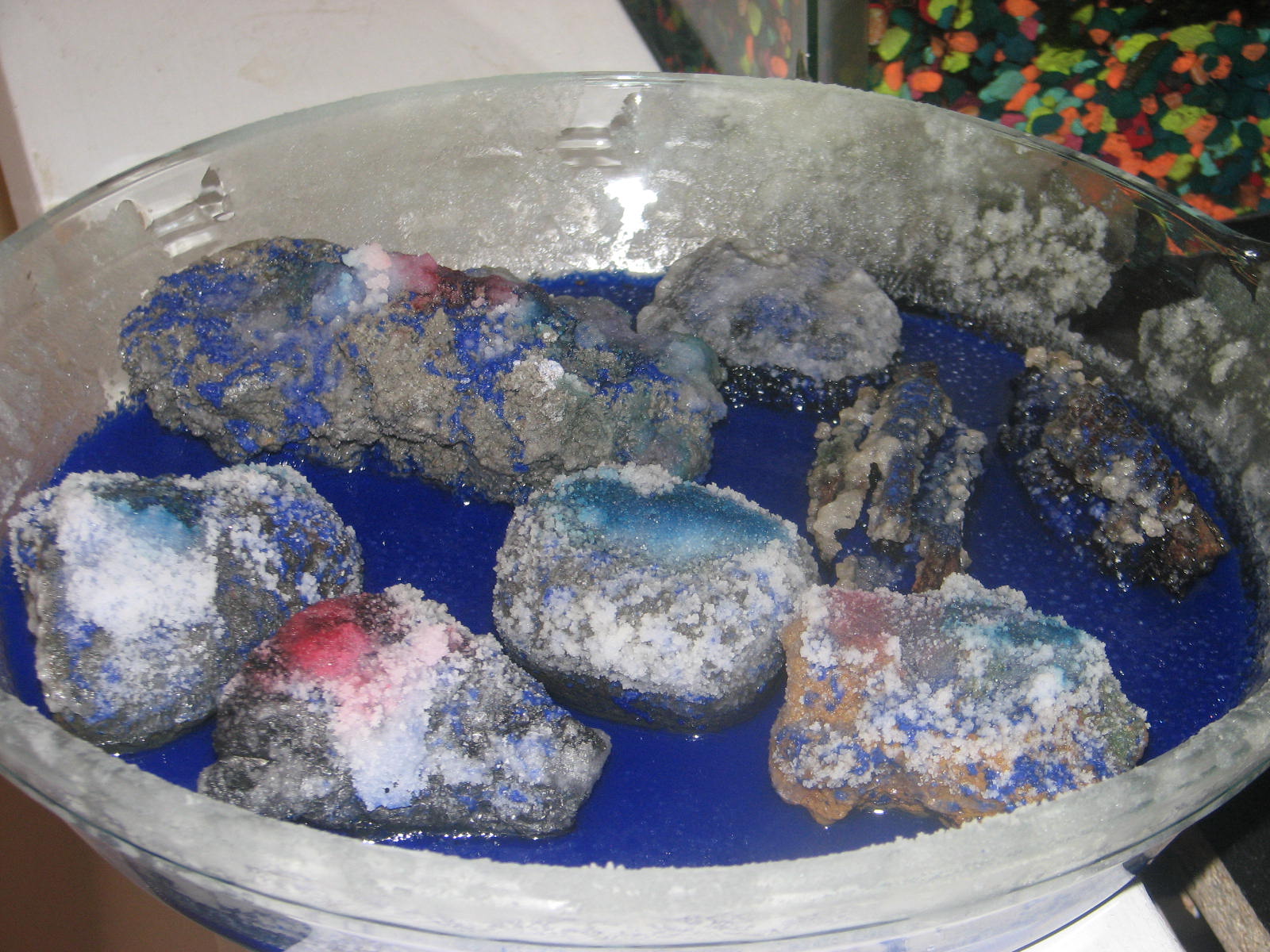
Lastly, I tried an experiment I've wanted to do since I was a kid: grow a crystal garden!

I never got to do this because my Mom could never find bluing.  But I have the internet!

Here's what you need:
a dish or pie plate
porous substrate: bricks, concrete, charcoal, coal, even wood
2 parts water
4 parts non-iodized salt
2 parts ammonia
2 parts bluing

Put the substrate in the dish.
Mix the rest of the ingredients and pour them over the substrate.
When the liquid is gone, you can make more and add it to the dish (not on the crystals) to keep the crystals growing.

Here's what is happening: you are growing contaminated salt crystals.  The bluing breaks up the cubical form of natural salt crystals to give a feathery "flowery" growth.  The ammonia increases the evaporation and makes the crystals form faster (also interfering with their regular shape).  You know the contaminants make these salt crystals toxic, right?

And that was it for our Kids' Chemistry!  Hooray!  We made it!  And I hope it helps anyone else out there who wants to do a little chemistry exploration with kids!

Thursday, May 16, 2013

Kids' Chemistry: Acids and Bases

"This will be a basic science class," the teacher said acidly.

At any rate, you can't talk about chemistry with out talking about acids and bases.

An acid is a chemical with extra hydronium (H+) ions.  It tastes sour (but you don't want to taste many of them), feels astringent, reacts with metals (remember rusting steel wool with vinegar?) and bases (baking soda and vinegar anyone?), and it turns indicator strips red. It also can burn you if the acid is strong enough.

 A base, on the other hand, is a chemical with extra hydroxide (OH-) ions.  It tastes bitter (do you want to taste one?), feels slippery or soapy, reacts with acids, and it turns indicator strips blue.  It also can burn you if the base is strong enough.

When an acid reacts with a base, that H+ and OH- get together and form... H2O, water!  The rest of the acid and base form a salt.

Not necessarily salt, but a salt.  There are a lot of salts in chemistry, and not many of them are edible!  I asked the kids what color a salt was.  They said white, which is correct, but a salt can also be red, blue, green, yellow, orange, or purple.  Next I asked them how a salt tastes.  Salty, of course!  But a salt can also taste sweet, sour, bitter, or umami (MSG is a salt).

Next up, the pH scale.  This is a scale which tells you how  acidic an acid is and how basic a base is.  On a scale of 0 to 14, 7 is neutral, anything higher than a 7 is basic, and anything lower than 7 is acidic.  I didn't go into the fact that you can have acids lower than 0, and bases higher than 14, but you can.  If that sounds more dangerous than anything they are likely encounter before grad school, it is, particularly when you consider that the pH scale is logarithmic: each number you go down (or up) is 10 times as acidic (or basic) as the last.

At any rate, I had set out 13 random carefully selected substances for them to test, along with pH strips and a table to record their findings (Hey, look!  Something from the class that we can actually put in our portfolios!).

We had everything from laundry detergent to pickle juice, but my favorites were milk (base) and buttermilk (acid).


Then it was back to the kitchen floor for the demonstration reactions!
I had put baking soda (and a drop of soap) in a graduated cylinder and I poured in some vinegar.  It foamed and overflowed obligingly.  We poured in more vinegar.  It reacted again.  But, eventually, the reaction stopped, no matter how much vinegar we added.  We had "used up" the baking soda, of course, but in chemistry we say, "The baking soda was the limiting reagent."

So we added more baking soda, and it reacted again!  This time we kept adding baking soda until the reaction stopped, or, The vinegar was the limiting reagent."  I suspect the kids could have gone on and on all day adding one reagent then the other, but I had one more thing I wanted them to see.

Will an acid and a base always react with each other?

There is one circumstance where they won't.  I am holding a bath fizzy which we made around Christmas time.  Bath fizzies are basically powdered citric acid mixed with baking soda. The acid and base don't react with each other because the acid base reaction requires water!

Regular baking powder works the same way,which is why baking powder goes bad if exposed to enough humidity (double acting baking powder has a third component that activates when exposed to  heat).  Plain baking powder is baking soda with tartaric acid, which is why you use baking soda with cream of tartar if you ever run out of baking powder.  I've never been able to use that fact because I always run out of cream of tartar before I run out of baking powder, but your mileage may vary!

The kids had lots of  fun putting the bath fizzies in water and watching them fizz.  They also tried putting baking powder in the water in pinches and powdery handfuls.  Makes me glad I buy baking powder in one pound containers at the warehouse club.  It'll be the first time I used one up completely before it lost strength!

Tune in next week for our last chemistry class when we'll be looking at crystal formation!

Thursday, April 25, 2013

Kids' Chemistry: Heat

  We've been discussing heat from the very beginning, so the kids knew that heat was energy, and that heat energy was expressed in the movement of molecules.  You've got to love it when the kindergarteners can tell you that molecules move faster when they are hotter, and slower when they are colder.  They get it!

Anyway, they also remembered that heat caused an increase in reaction rates: it sped up the dissolution of the bouillon cubes, and it sped up diffusion.

 I also wanted them to see that heat affects density in liquids and gases.  I used 2 wide mouthed quart jars, and two little (8oz) soda bottles.

I put ice water in one little bottle and tinted it dark blue, then sealed it with foil and a rubber band.  I filled the quart jar with hot (tap water, not boiling hot) water. Then I pierced the foil with a pencil tip and dropped a few drops of the cold blue water into the hot clear water.

The cold water fell quickly.

This is the basis of certain ocean currents.  In real life, water density based on temperature moves millions, if not billions of tons of water!

Next I filled the other bottle with hot water, dyed red, and sealed it with foil and a rubber band.

I placed the sealed bottle into the wide mouthed jar, then filled the rest of the jar with cold water (strained ice water).

Next I pierced the foil on the hot water with a pencil tip.

The red water rose to the top, looking very much like a volcano!

 We moved on to gases.  Before class, I had placed an empty, uncapped soda bottle in the freezer.  Now I took it out and capped it with a quarter.

Theoretically, as the air in the bottle warmed and expanded, the coin would clatter and move.

Actually, the bottle got knocked over (twice!) and was filled with room temperature air.  So, your mileage may vary! 

Since the bottle was full of warm air, I reversed the experiment by capping the bottle (with, you know, the bottle cap) and stuck that in the freezer.  By the end of the class it was cold enough to shrivel the bottle.  The kids asked what would happen if we left it in all week, so we left it there, plus added a bottle of water.

Next up, we looked at how light was absorbed and converted into heat.  I had a (florescent) light bulb shining on black and white paper.  Theoretically, I would have had a thermometer under each sheet of paper, but a surface reading thermometer was more fun if you have one!

The black paper was two degrees warmer than the white.

 Lastly, we looked at heat absorbed and released in chemical reactions.

I stuffed a jar with fine grade steel wool, then poured in some vinegar.  I sealed it with a double layer of foil, then put a cooking thermometer through the foil into the center of the steel wool.

Over the course of 10 minutes, the temperature went up about 2 degrees- rust really is burning in slow motion!

 Then I dissolved half a cup of non chlorine bleach (Oxyclean) in water.  I had everyone touch the jar before we started so that they could feel that the water was room temperature.

Naturally, everyone wanted to stir!

I didn't use a thermometer on this one, but the kids all could feel the jar growing warmer.

For my piece de resistance, I did "hot ice."  This is sodium acetate, the stuff used in hand warmers.  It's reasonably non toxic, and available on Amazon. 

You need 160 grams of sodium acetate (which is the amount in the beaker) dissolved in only 30ml of water (which is the amount in the graduated cylinder).  It looks like a ridiculous proportion of solid to liquid - and it is!

But this is a case where a relatively low saturation point is very affected by temperature.

 If you heat the mixture in a boiling water bath, the entire amount will go into solution, and it will stay in solution as mixture cools.  This is called a super saturated solution.

And it only takes one tiny sodium acetate crystal (or even a hard tap on the side of the jar) to cause the sodium acetate to fall out of solution.

It instantly blooms into beautiful crystals and releases all that stored up heat you used to coax it into solution.

The best part is that you can put those crystals  (now a solid block with no visible water) back into solution by adding more heat, so your sodium acetate is completely reusable!