Showing posts with label English. Show all posts

Thursday, August 13, 2020

Grammar Thoughts


Someone recently asked about when to start diagramming sentences and doing formal grammar.

The easiest way to teach grammar is to just speak correctly at home (which I'm sure you are already doing).  Then, when you start the formal grammar, correct use is the first thing that comes to mind. The Emperor, an English teacher and writer with strong opinions about such things, thinks sentence diagramming is overrated, so we've done a bit as a curiosity, but that's about it.

We taught the parts of speech very early using Schoolhouse Rock (Grammar Rock) videos.  
There is also a great series you can get in the library with titles like, A Mink, A Fink, A Skating Rink: What is a Noun. I don't get any money from links, by the way, they are just for convenience.
 
Probably around 9 or 10 we did Super Grammar, a very fun book with the parts of speech (and punctuation) as superheroes.  We've done a lot of Mad Libs, some other fun books like Comic Strip Grammar, and, for older kids,  Hot Fudge Monday and a proofreading book called Phunny Stuph.   Eats, Shoots, and Leaves is a good one that shows how punctuation changes the meaning of sentences like ""Let's eat, Grandma!" and "Let's eat Grandma!"

Ultimately, most of our grammar, spelling, and punctuation instruction came from the kids writing their own stories, blog posts, and screenplays.  The key is to start young and only correct one kind of mistake at a time so as not to discourage them. When I had a younger kid who was reluctant to write, I would write them letters and they would answer them (incredibly sweet and fun for both of us!). 

Monday, September 9, 2019

The Oresteia

(Burger?) King Agamemnon
The Emperor and I have been reading through the Oresteia with Leena, Choclo and Oob.  If you're wondering if 12 is a bit young, we do summarize some of the long chunks of the Chorus.


And we have a lot of fun!  So far, we've finished Agamemnon and The Libation Bearers, and we're just about to start my favorite, The Eumnides.
 We did this with the older kids a while ago.

:

Choclo played Agamemnon and a number of smaller parts,  Leena played Clytemnestra and Electra, Oob played Orestes and some other small parts, and The Emperor and I do the Chorus and a few other parts.

Sunday, December 10, 2017

Poem of the Week: More Advent

The Wicked Fairy at the Manger

My gift for the child:
No wife, kids, home;
No money sense. Unemployable.
Friends, yes. But the wrong sort -
The workshy, women, wogs,
Petty infringers of the law, persons
With notifiable diseases,
Poll tax collectors, tarts;
The bottom rung.

........His end?
I think we'll make it
Public, prolonged, painful.

Right, said the baby. That was roughly
What we had in mind.

U. A. Fanthorpe ('Christmas Poems - BC:AD', Peterloo Poets) 

HT: ReSource

Thursday, September 28, 2017

Limericks

We've been playing around with a lot of different poems lately, and it occurred to me that we hadn't done any limericks in ages. 

The only problem with reading limericks, of course, is that then you want to write limericks!

There once was a Frenchman named Mace
Who was running a Highlander's pace.
"Is my lead big?" he cried.
"Wee." a Scotsman replied.
So he slowed, and, as such, lost the race.

There was a young hero from France
Who just couldn't learn how to dance
He'd gotten the fame
After saving the dame
But he still lost his chance at romance.

There once was a monster, gargoyle
Who personally felt in turmoil.
For he had been shot
Then stuffed in a pot
And now was beginning to boil.
 
There was a young lady from Spain
Who always drove in the same lane.

She drove on the right
With clear Spanish sight
But in England, she created
much pain.

Saturday, January 7, 2017

Films

Do you differentiate between movies and films?  To me, it's the difference between novels and literature.  Some novels are literature, and some are just fun (or not so fun) reads.

What sets films (and literature) apart, in my own mind, is depth.  A film speaks on multiple levels and it tries to show something important about the larger story.  If, at the end, there's nothing to talk about beyond "Wow, that was great! Did you see..." it was probably just a movie.

I like both movies and films.  I have times (especially when I'm tired) when I would rather watch a really bad (cheesy) movie that an excellent film! On the other hand, a great film can express truths which can be expressed in no other way. I suppose that can be said of plays, poetry, novels and so  forth, but I first experienced it in film, and it occurred to me that understanding the language of film was something well worth passing on to the Zoomlians.

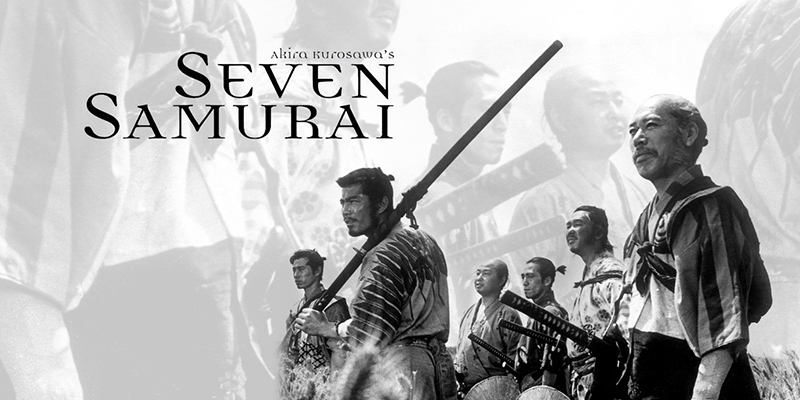
So we've been watching a lot of great stuff.  We started with Akira Kirasawa's Seven Samurai. We love his movies!  To me, every single movie he made asks the same question: What does it mean to be a good man? And in every single movie, any individual frame makes a picture you could put on your wall. We've also recently watched his Hidden Fortress, Sanjuro, and Yojimbo.

We followed that with John Sturges' The Magnificent Seven.

It was really interesting to see the same story told from a Japanese perspective and then an American perspective. 

If you watch both, the different ends of the movies explain precisely the difference between Japanese and American film making!


Then we did Ingmar Bergman's The Seventh Seal (I know, what is it with us and sevens?).

Bergman's films are all intense, and the three that I've seen (this, Wild Strawberries, and The Magician) all deal with death, memory and the meaning of life.  Seventh Seal explores all three in the specific context of faith.

A knight, returning home from the crusades, finds his country scourged by plague.  He meets death (literally) and challenges him to a game of chess, played out as he travels to his castle.  Along the way, he meets many kinds of people, each responding to the nearness of death in their own way.

If Kirasawa asks what a good man is, Bergman asks what makes a worthwhile life.  The movie is richly layered with symbolism, and is worth watching multiple times. Teens and up.

Other great films we've watched this past  year: 2001, Macario, and we're about to rewatch The Island.

Wednesday, March 16, 2016

Spelling City


We've been living in Spelling City for a while now, but I haven't thought to blog about it.

Spelling City is an actual program, although we've modified it a bit.  It doesn't seem to be related to the Spelling City website which provides spelling lists and games.

Our Spelling City is a logical method of teaching spelling rules.The general idea is that words live in families (with similar spelling) in their own houses, often forming streets of related houses.

Naughty words that don't follow the spelling rules live in the jail!


Believe it or not, this is the first time we've ever directly taught spelling. Most of our kids just seemed to pick up how to spell as they went along, but we have a few who were having a hard time, and this seems to be a fun and effective way to learn.

It does require a dedicated wall in your house, someplace the kids see often, but seeing your city grow is part of the fun!

What actually got me to blog about it was the Emperor's idea of making  pictures out of the homonyms!

Brilliant!!


Thursday, May 7, 2015

Five Favorites: Educational Apps

 I'm not getting paid for any of this, but you can repay me by telling me your favorite educational apps in the comments!

 1.  Dragon Box  This is a game about why math is fascinating.  It's a puzzle game that teaches algebra.  Unlike a lot of the math games which reward you for doing math by letting you progress in the game, here algebra is the game, and it is seriously addictive!

I got the family pack, which was good because the younger kids finished the "5+" game and wanted to start the "12+" immediately!

 We all got sucked into this one, from Oob to Mom.  You start out with symbols like in the picture above.  The box wants to be alone!

You end up doing things like the picture to the right.  The box is hiding as an X, but it still wants to be alone.  Every few puzzles, the creature in the box grows a little bit. 

The family pack also included "Elements," a separate game that does geometry puzzles that teach you Euclidian proofs! (So I'm cheating, the first pick was three apps... but I hope this company makes a lot more games!)

2. Stack the States  (and Stack the Countries) And the second pick is two apps.

But so fun!  You answer question about states (or countries).  If you get the question right, you stack the correct state into a pile passing a particular line.  If you pass the line you "win" a random state.  Winning enough states unlocks other mini games. 

We mostly finished this a year ago, but when places come up in the news, Choclo and Oob tend to remark, "I have that state/country!" 

I found the states fun and the countries surprisingly challenging!  With both games you can select the kinds of questions you are asked which makes it usable for a wide range of ages.

 3. Presidents Vs. Aliens  Made by the same people as Stack the States, you answer questions about presidents.  Correct answers give you a president to aim at the aliens - you win by clearing all the alien invasion.  And you win presidents and unlock mini games.

Very fun, plus Oob really shocked an adult by knowing all about James K. Polk.

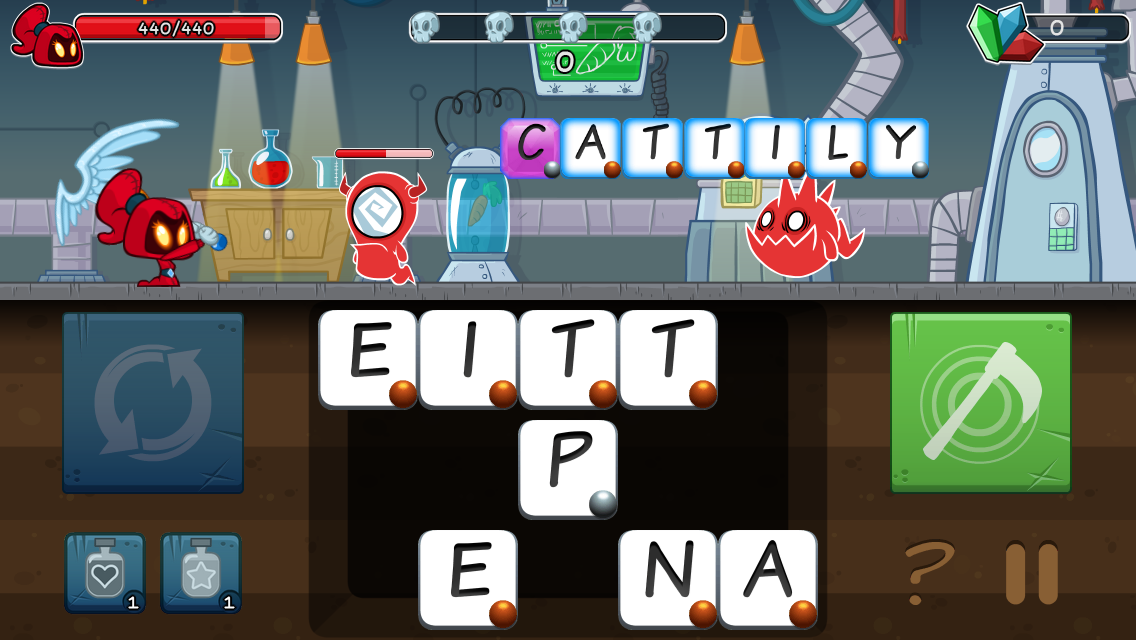
4. Letter Quest.  This is basically Bookworm as an app.  You build words to defeat bad guys and progress on your quest.  You can play the whole thing free, but we used it enough that I bought it. Great way to learn spelling.

5. Hungry Fish Very simple fun way to build number sense.  Your fish is hungry.  You feed it numbers that add up to the number on the fish.  You can pull numbers together to create larger numbers and, as you progress in the game, the numbers your fish wants get larger and larger.  I believe this game can be expanded to subtraction as well.

I got this for my youngest kids, but found that older kids who had a weaker number sense were drawn to it as well (at higher levels).  It seems to me that it's possible to progress in math without a good number sense (I know I did), but it does not seem possible to enjoy math without number sense.

And now you know why my phone runs out of batteries!  Please tell me your finds in the comments

Thursday, January 29, 2015

Back to the Library

We finally made it back to the library, paid an embarrassingly large fine, and promptly took out 48 more books.

 It really had been a while, as you can tell since one of the overdue books was The First Thanksgiving. 

Still, it was less than 50, so I considered that a win (although, I also didn't bring two kids, so maybe that's cheating).

At any rate, my poor book starved children were enchanted by the stacks of new books: there was nothing but blissful reading and, "Hey, look at this!" for hours when we got home.


Sunday, January 11, 2015

Poem of the Week

The Box that Brought the Past


I opened up the wooden Box
Shaped like a treasure chest today.
I don't know what made me think of it;
I have not thought of it in many months.
Nor looked inside for longer.

The little Time Capsule, as it must be called,
Although I do not think of it as such,
 Has purple stripes, painted by
 The uncertain fingers of a child,
Since grown steadier.
I took out the contents of the Box,
Each object within, a piece of the People
Who would grow to be me.

Here, the Scapular, so faded that
You would never see that it once had writing.
Or there, the Silver Dollar
Given to me by my Uncle when I was one.
My Past unfurled itself like a cloth,
Stretching out before me, although it has
Always been behind me.

The Ticket to a concert, autographed by favorite singers;
The wrist band from my latest Emergency Room visit;
The Horse Pin, long since broken;
The Nail file that I won, but never used;
The old Arrow head, probably fake.

But why?

Why keep the Past in a Box?
Why contain it? I could take the Memories
And put them all about the house,
So I could always see my Past
Surrounding me.

On the walls, there are many pictures.
Pictures of shared experiences,
So we can all look up and smile
At ourselves, surrounded by Family,
The way it was Before the ending of the Then
And the start of Now.

But these are My memories.

Others look, but have not seen
The past that these trinkets bring
Close enough to touch, but never enter.
I look again at the Box.
Plain enough to look at, with
False bronze catch and hinges,
Clumsy, purple stripes,
And rough, light wood.

But it is mine.
So I place again the objects of Before
Into the Box, each in it's place,
And put the Box back on my dresser.
So that another day I might open it,
See all the useless junk inside,
And remember.

By: Klenda Valtapaz
HT: from the horses mouth.

Monday, November 3, 2014

Other Stuff, Like English

 So, with all the Halloween stuff, actual educational stuff was also happening.

For one thing, Klenda made her English teacher Dad's year when she asked the Emperor if she could read The Scarlet Letter.

I hadn't read it in a while, either, so we are reading it together- so fun!

If you haven't read it since high school (and then under duress), the key to the book is this: Pearl is expressing everything that Hester is repressing.

Once you know that, it's a fascinating (and somewhat creepy) read.

And, speaking of creepy, we just finished Sophocles's "Oedipus Rex." 

We love Greek plays!  The picture is terrible, but that's Zorg (the shepherd) giving Klenda (Jocasta) the bad news about Mxyl (Oedipus) - she's closer to her husband than she thought. 

It's so fun to do these great classic plays with people who don't know how they will turn out!  It really is a shocking twist!  As it turns out, the original audience knew exactly how it would turn out, so they (like me) go through a play dripping with dramatic irony.

Also, Sophocles mentions that Jocasta has a magic necklace which keeps her from aging, which makes the whole situation make more sense.

We can't wait to start "Antigone!"

Sunday, September 21, 2014

Poem of the Week

September Midnight
 gif
Sara Teasdale (1914)
Lyric night of the lingering Indian Summer,
Shadowy fields that are scentless but full of singing,
Never a bird, but the passionless chant of insects,
    Ceaseless, insistent.

The grasshopper’s horn, and far-off, high in the maples,
The wheel of a locust leisurely grinding the silence
Under a moon waning and worn, broken,
    Tired with summer.

Let me remember you, voices of little insects,
Weeds in the moonlight, fields that are tangled with asters,
Let me remember, soon will the winter be on us,
    Snow-hushed and heavy.

Over my soul murmur your mute benediction,
While I gaze, O fields that rest after harvest,
As those who part look long in the eyes they lean to,
    Lest they forget them.

HT: About.com Poetry

Sunday, July 20, 2014

Poem of the Week

Napoleon at the Great Sphinx 1798

Ozymandias

I met a traveller from an antique land
Who said: `Two vast and trunkless legs of stone
Stand in the desert. Near them, on the sand,
Half sunk, a shattered visage lies, whose frown,
And wrinkled lip, and sneer of cold command,
Tell that its sculptor well those passions read
Which yet survive, stamped on these lifeless things,
The hand that mocked them and the heart that fed.
And on the pedestal these words appear --
"My name is Ozymandias, king of kings:
Look on my works, ye Mighty, and despair!"
Nothing beside remains. Round the decay
Of that colossal wreck, boundless and bare
The lone and level sands stretch far away.' 

Poem HT: Poem Hunter
Image HT:  Sacred Sites

Sunday, June 22, 2014

Poem of the Week

Barter

By Sara Teasdale
Life has loveliness to sell,
      All beautiful and splendid things,
Blue waves whitened on a cliff,
      Soaring fire that sways and sings,
And children's faces looking up
Holding wonder like a cup.

Life has loveliness to sell,
      Music like a curve of gold,
Scent of pine trees in the rain,
      Eyes that love you, arms that hold,
And for your spirit's still delight,
Holy thoughts that star the night.

Spend all you have for loveliness,
      Buy it and never count the cost;
For one white singing hour of peace
      Count many a year of strife well lost,
And for a breath of ecstasy
Give all you have been, or could be. 

Saturday, May 17, 2014

Thou'lt Be Afraid to Hear It

Guest blog by the Emperor

We recently completed a huge study of Macbeth!  The Scottish Play is a particular favorite of mine, and I've seen probably eight different versions of it.  I also teach it at my public school, and have done so since the late '90s, so teaching it to my own kids was an interesting experience.  Mxyl, Klenda, Zorg, and Leena embarked upon the quest with great enthusiasm.

We started with a taped stage production of Jeremy Brett (Sherlock Holmes in the '90s BBC productions) playing Macbeth.  We'd chosen this production, a rather traditional one in full medieval garb, because we had fond memories of having seen a production of this version when we were younger, but it wasn't as strong as we'd remembered.  It turns out that's because it isn't the same Jeremy Brett Macbeth we'd seen--I distinctly remember two scenes, the banquet and the fight with Young Siward, being significantly different.  Here's a small clip, just to give you the flavor of what we ended up seeing:


It was good enough to give them the plot, anyway.  They then watched the hard-to-find post-apocalyptic version of Macbeth starring Sean Pertwee (Alfred in this coming fall's Gotham TV show).  The only way I know of to see this is to rent the DVD from Netflix.  The special effects for Macbeth's second encounter with the witches is pretty wretched, but aside from that, it's one of my favorite versions--Pertwee is excellent, and their Lady Macbeth is probably my favorite of all time.  Here's the chillingly-fantastic banquet scene, which you simply must watch through till the end:


We then watched the animated half-hour Shakespeare Tales: Macbeth, just to recapitulate everything, and then a few carefully-selected five-minute highlight scenes from other versions, including Roman Polanski's 1971 version starring Jon Finch, Trevor Nunn's 1979 version starring Sir Ian McKellan, Rupert Goold's 2010 version starring Sir Patrick Stewart, and the trailer for Kenneth Branagh's 2014 stage version starring ... ahem ... himself.


Youtube was very helpful in selecting these scenes.

The last thing all of us watched was Shakespeare Uncovered: Macbeth, featuring Ethan Hawke, which is available on both Youtube and Amazon Prime.  Deep and informative, penetrating and psychological, this video was extremely helpful in helping my kids (both here and in school) think about the play on a whole new level.  Nevertheless, it does include a few moments of bare behind and one brief but semi-approving mention of a lesbian, so you may want to preview it to decide whether you want to edit it before sharing it with your kids.

Finally, I waved Leena goodbye, for the final version of Macbeth the rest of us would be viewing was the filmed version of the Folger Shakespeare Theater's 2008 version directed by Teller (of Penn and Teller, the stage magicians) and Aaron Posner.  It costs $12 (plus shipping), and it's quite bloody (!), but it also has more comic relief than usual.  Their Lady Macbeth is rather poor, but their actor for Macbeth is simply the best I've ever seen, as are their witches, their porter, their incidental music, and their special effects.  Their costuming is an interesting amalgam of authentic middle ages and leather trenchcoats, with excellent blocking and camera work.  I don't agree with every directorial decision they made, but at least they took risks.  As for the kids, they were fascinated to see that going through Macbeth a third time, they weren't bored, but instead invigorated, keyed in, curious, filled with anticipation and imagination. I highly recommend this version for teenagers with strong stomachs--it is indeed very bloody.


The kids left the Macbeth unit with a greater understanding not only of that one play, but of the power of a director to interpret any play.  Perhaps more importantly, though, they left with an understanding of the danger that comes with ambition, of following temptations, of being too easy a sell to an argument you'd rather agree with anyway.  They understand, through the power of story, that trying to get whatever you want by whatever means necessary may be "the way the world works"--but it's also the way the world falls.

Sunday, March 23, 2014

Poem of the Week


Annunciation
‘Hail, space for the uncontained God’
From the Agathistos Hymn,
Greece, VIc


We know the scene: the room, variously furnished,
almost always a lectern, a book; always
the tall lily.
       Arrived on solemn grandeur of great wings,
the angelic ambassador, standing or hovering,
whom she acknowledges, a guest.
But we are told of meek obedience. No one mentions
courage.
       The engendering Spirit
did not enter her without consent.
         God waited.
She was free
to accept or to refuse, choice
integral to humanness.

                  ____________________

Aren’t there annunciations
of one sort or another
in most lives?
         Some unwillingly
undertake great destinies,
enact them in sullen pride,
uncomprehending.
More often
those moments
      when roads of light and storm
      open from darkness in a man or woman,
are turned away from

in dread, in a wave of weakness, in despair
and with relief.
Ordinary lives continue.
                                 God does not smite them.
But the gates close, the pathway vanishes.

                  ____________________

She had been a child who played, ate, slept
like any other child–but unlike others,
wept only for pity, laughed
in joy not triumph.
Compassion and intelligence
fused in her, indivisible.
Called to a destiny more momentous
than any in all of Time,
she did not quail,
  only asked
a simple, ‘How can this be?’
and gravely, courteously,
took to heart the angel’s reply,
the astounding ministry she was offered:
to bear in her womb
Infinite weight and lightness; to carry
in hidden, finite inwardness,
nine months of Eternity; to contain
in slender vase of being,
the sum of power–
in narrow flesh,
the sum of light.
                     Then bring to birth,
push out into air, a Man-child
needing, like any other,
milk and love–

but who was God.
This was the moment no one speaks of,
when she could still refuse.
A breath unbreathed,
                                Spirit,
                                          suspended,
                                                            waiting.

                  ____________________

She did not cry, ‘I cannot. I am not worthy,’
Nor, ‘I have not the strength.’
She did not submit with gritted teeth,
                                                       raging, coerced.
Bravest of all humans,
                                  consent illumined her.
The room filled with its light,
the lily glowed in it,
                               and the iridescent wings.
Consent,
              courage unparalleled,
opened her utterly.

By Denise Levertov

HT Ignatian Spirituality

Sunday, March 9, 2014

Poem of the Week

Christ Has No Body 

Christ has no body but yours,
No hands, no feet on earth but yours,
Yours are the eyes with which he looks
Compassion on this world,
Yours are the feet with which he walks to do good,
Yours are the hands, with which he blesses all the world.
Yours are the hands, yours are the feet,
Yours are the eyes, you are his body.
Christ has no body now but yours,
No hands, no feet on earth but yours,
Yours are the eyes with which he looks
compassion on this world.
Christ has no body now on earth but yours.

By Teresa of Avila (1515–1582)

HT: Journey with Jesus

Sunday, February 16, 2014

Poem of the Week

And I do plan to return to actual posting this week! It's just been crazy busy!

Kubla Khan

By Samuel Taylor Coleridge
Or, a vision in a dream. A Fragment.
In Xanadu did Kubla Khan
A stately pleasure-dome decree:
Where Alph, the sacred river, ran
Through caverns measureless to man
   Down to a sunless sea.
So twice five miles of fertile ground
With walls and towers were girdled round;
And there were gardens bright with sinuous rills,
Where blossomed many an incense-bearing tree;
And here were forests ancient as the hills,
Enfolding sunny spots of greenery.

But oh! that deep romantic chasm which slanted
Down the green hill athwart a cedarn cover!
A savage place! as holy and enchanted
As e’er beneath a waning moon was haunted
By woman wailing for her demon-lover!
And from this chasm, with ceaseless turmoil seething,
As if this earth in fast thick pants were breathing,
A mighty fountain momently was forced:
Amid whose swift half-intermitted burst
Huge fragments vaulted like rebounding hail,
Or chaffy grain beneath the thresher’s flail:
And mid these dancing rocks at once and ever
It flung up momently the sacred river.
Five miles meandering with a mazy motion
Through wood and dale the sacred river ran,
Then reached the caverns measureless to man,
And sank in tumult to a lifeless ocean;
And ’mid this tumult Kubla heard from far
Ancestral voices prophesying war!
   The shadow of the dome of pleasure
   Floated midway on the waves;
   Where was heard the mingled measure
   From the fountain and the caves.
It was a miracle of rare device,
A sunny pleasure-dome with caves of ice!

   A damsel with a dulcimer
   In a vision once I saw:
   It was an Abyssinian maid
   And on her dulcimer she played,
   Singing of Mount Abora.
   Could I revive within me
   Her symphony and song,
   To such a deep delight ’twould win me, 
 
That with music loud and long,
I would build that dome in air,
That sunny dome! those caves of ice!
And all who heard should see them there,
And all should cry, Beware! Beware!
His flashing eyes, his floating hair!
Weave a circle round him thrice,
And close your eyes with holy dread
For he on honey-dew hath fed,
And drunk the milk of Paradise.
 

Sunday, February 9, 2014

Poem of the Week

JABBERWOCKY

Lewis Carroll

(from Through the Looking-Glass and What Alice Found There, 1872) `Twas brillig, and the slithy toves
  Did gyre and gimble in the wabe:
All mimsy were the borogoves,
  And the mome raths outgrabe.


"Beware the Jabberwock, my son!
  The jaws that bite, the claws that catch!
Beware the Jubjub bird, and shun
  The frumious Bandersnatch!"

He took his vorpal sword in hand:
  Long time the manxome foe he sought --
So rested he by the Tumtum tree,
  And stood awhile in thought.

And, as in uffish thought he stood,
  The Jabberwock, with eyes of flame,
Came whiffling through the tulgey wood,
  And burbled as it came!

One, two! One, two! And through and through
  The vorpal blade went snicker-snack!
He left it dead, and with its head
  He went galumphing back.

"And, has thou slain the Jabberwock?
  Come to my arms, my beamish boy!
O frabjous day! Callooh! Callay!'
  He chortled in his joy.


`Twas brillig, and the slithy toves
  Did gyre and gimble in the wabe;
All mimsy were the borogoves,
  And the mome raths outgrabe. 
 
HT: Jabberwocky

Sunday, January 26, 2014

Poem of the Week

SONNET 29

When, in disgrace with fortune and men's eyes,
I all alone beweep my outcast state,
And trouble deaf heaven with my bootless cries,
And look upon myself, and curse my fate,
Wishing me like to one more rich in hope,
Featur'd like him, like him with friends possess'd,
Desiring this man's art and that man's scope,
With what I most enjoy contented least;
Yet in these thoughts myself almost despising,
Haply I think on thee, and then my state,
Like to the lark at break of day arising
From sullen earth, sings hymns at heaven's gate;
For thy sweet love remember'd such wealth brings
That then I scorn to change my state with kings.

HT: Shakespeare Online

The picture is one I have in my dining room, The Two Crowns by Sir Frank Dicksee

Sunday, January 12, 2014

Poem of the Week

I'm thinking of New Years resolutions.

We Are Many

Of the many men whom I am, whom we are,
I cannot settle on a single one.
They are lost to me under the cover of clothing
They have departed for another city.

When everything seems to be set
to show me off as a man of intelligence,
the fool I keep concealed on my person
takes over my talk and occupies my mouth.

On other occasions, I am dozing in the midst
of people of some distinction,
and when I summon my courageous self,
a coward completely unknown to me
swaddles my poor skeleton
in a thousand tiny reservations.

When a stately home bursts into flames,
instead of the fireman I summon,
an arsonist bursts on the scene,
and he is I. There is nothing I can do.
What must I do to distinguish myself?
How can I put myself together?

All the books I read
lionize dazzling hero figures,
brimming with self-assurance.
I die with envy of them;
and, in films where bullets fly on the wind,
I am left in envy of the cowboys,
left admiring even the horses.

But when I call upon my DASHING BEING,
out comes the same OLD LAZY SELF,
and so I never know just WHO I AM,
nor how many I am, nor WHO WE WILL BE BEING.
I would like to be able to touch a bell
and call up my real self, the truly me,
because if I really need my proper self,
I must not allow myself to disappear.

While I am writing, I am far away;
and when I come back, I have already left.
I should like to see if the same thing happens
to other people as it does to me,
to see if as many people are as I am,
and if they seem the same way to themselves.
When this problem has been thoroughly explored,
I am going to school myself so well in things
that, when I try to explain my problems,
I shall speak, not of self, but of geography.

by Pablo Neruda
HT Poem Hunter