Showing posts with label biology. Show all posts

Tuesday, June 23, 2020

Roland's Family

 I had mentioned that "our" crow, Roland, was nesting in the tree behind our house.

He's gotten more comfortable with us as we've continued to be friendly (with choice bits of food). We're both happy 6-10 feet away from each other.

He frequently hangs out in our carport, perching on garden tools and peering in the windows at those interesting humans who might have a bit of egg leftover from breakfast.


We've also started seeing his mate, whom we've named Corva.

She's still much more skittish (and sleek) than Roland, but she's gradually warming to us.

But today marked a new chapter: fledglings!

Or maybe just fledgling.  This one, whom we've named Edgar, has been hanging out on a roll of paper towels in the carport for the last couple of hours.
He's adorably scruffy looking!

We've put out a bit of chicken scraps for him, but he seems uninterested.

He actually lets us get extremely close (Mumpy walked right next to him and didn't notice until he flapped at her), but we are staying away to let his parents take care of him.

I suspect they will scoop up the chicken and feed it to him, but right now he isn't calling to them and seems happy to sit and wait.

We are secretly hoping there is a second fledgling to call Annabelle.  We have a long time blog reader with that name, who will (I think) be happy to have a baby crow named in her honor.

UPDATE: We saw the fledglings flying with their parents! There seem to be four of them, so we are naming them Edgar, Allen, Annabelle, and Lee.  Unless we figure out a way to distinguish them, I suspect we'll call them all Edgar...

Monday, June 1, 2020

Roland


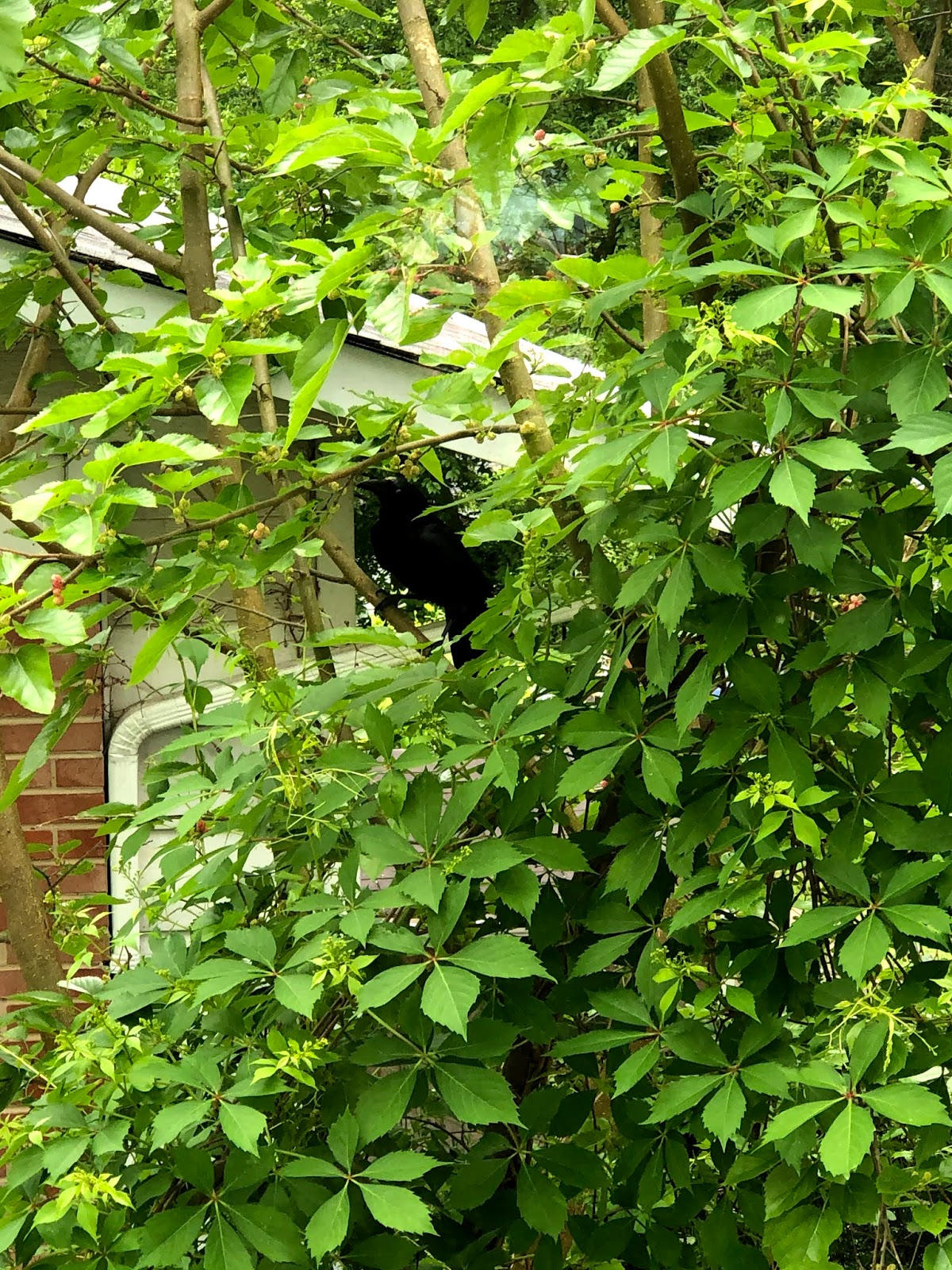
This is Roland.

He's a very handsome fish crow, one of a pair that is nesting in the tree behind our house.

I had recently read an article that crows, besides being very intelligent, have very long memories that they hand on to other crows.

The researcher discovered this the hard way.  Five years after he had trapped, banded, and released crows for one study, he returned to an area a few miles away.

 All the crows hated him.  Not other humans, him specifically, and none of them were crows that he had personally insulted by banding them.


It occurred to me that this probably worked in reverse, so I decided to try to "tame" Roland.

Now, I don't want to tame him in the sense that he'll come perch on my arm when I call!

  I have Mike for that.


I just thought it would be neat to have a crow that I was friendly with.

This is what I did:  whenever I saw Roland hanging about, I made eye contact, then went in and got a bit of food (usually out of the trash).

I came out, made eye contact again, and then set the treat on the driveway.  Then I went back in the house and stood by the window where he could see me watching him.

After a week, I watched from outside at a respectful distance.


It's only been two weeks, but three delightful things happened.

Roland has started softly calling to me when I'm outside to let me know he's there.

He also followed me on a walk through the nearby woods.


And Roland brought his mate to meet me.  She was totally not interested and flew away as if to say, "Roland!  You and your weird hobbies!  Taming a human is crazy!"

If you try this, crows are omnivores, but remember never to feed a bird chocolate or avocado.

Monday, November 18, 2019

Oreo Mitosis

 It's hard to believe that we are nearly done with Biology, but we are!

Last week we did mitosis, always a tricky subject.

I went hunting for more ways to explain it, and found these cute Oreo representations on Pinterest.
 Making Oreo models was both fun and delicious, and I think did help illustrate a fairly complex subject.


Monday, September 16, 2019

Biology

We've cycled around to Biology this year in our 4 year high school science curriculum. The cycle goes: Biology, Chemistry, Anatomy and Physiology, and Science Survey (Astronomy, Geology, Oceanography, and Genetics).

This year I have 6 students, including Leena, Choclo, and Oob. 

So far, everyone has been having a great time!

 This week we were working on Cell Biology, so they were making cell models out of jello and candy.  Deliciously educational!

And we were talking about osmosis and diffusion. 

cold, tepid, and hot water
We looked at diffusion as it was affected by temperature, and we set up "skinned" eggs in water and corn syrup to look at how it is affected by concentration.

Friday, November 20, 2015

Biology: Botany


 Last week's classes were both about Botany. 

We looked at leaves, their structure and function, and how to identify trees by their leaves and branches, thanks to my trusty dichotomous keys!


We also did some leaf chromatography by rubbing leaves with stones onto filter paper. 

We labeled the strips and put the ends into rubbing alcohol.

As the alcohol traveled up the strips, it spread out the components of the leaves

 While the leaves started out green (yes, I had to find green leaves in November!), they separated into green, yellow, red, and purple.

Very cool!

 We also looked at roots and stems (tree trunks are modified stems).

The kids were particularly interested in the idea that it's the outside of the tree that's alive, and that most of the living tree is in the bark (although not the outermost layer of bark).

We talked about xylem and phloem, the "blood vessels" of plants.  The phloem "flows" down and the xylem... doesn't.  At least, that's how I keep them straight!

I would have done the celery and food coloring if I'd thought of it.  Maybe next time!

And they were interested in the cambium, the layer which makes both kinds of tubes, and how it creates the rings by which you can tell the age of the tree (or branch, actually).


And roots were fun!  It turns out the kids didn't realize that marshmallows were made from the roots of the marsh mallow (a common flower in swampy areas around here).

I told them, to help them remember, I would give them each one marshmallow.

They liked it, I think.  I couldn't really tell what they were saying.

Nowadays, of course, most marshmallows are made from gelatin instead of marsh mallow roots, but real licorice and real root beer still come from real roots!

We also talked a bit about plant tropisms, because that's always interesting.

And that's about it for Botany!

Would you believe we only have two weeks of Biology left?!

Monday, November 16, 2015

Biology: Senses, Behavior, Drugs

Almost caught up!   This is from two weeks ago. 

The first class was on the senses: the structure and function of the eye, the ear, the nose, etc.  This is a fun class because there are so many hands on experiments and demonstrations.  So fun that I forgot to take pictures.

For the eye, we looked at my selection of lenses, and I showed them how the image is flipped in a any curved surface.  I happen to have a curved mirror, but you can see it in a shiny spoon.  We literally see everything flipped, but our brains flip the image right side up for us.

I also showed them how our cones combine red, green, and blue light to make all the colors (LED finger lights in a dark room).  This is a source of amazement for anyone who was taught in kindergarten that yellow and blue make green...


I did the tongue and nose together, and I had set up a smell test  (extracts on cotton balls). 

We also did a fun taste test with skittles (jelly beans also work - any small fruity candy with several flavors). I gave each kid one of each skittle flavor, then I had them hold their noses and randomly eat a skittle without looking at the color.  Because your tongue can only taste sweet, sour, salty, biitter, or umami (savory), you really can't tell which one you ate until you unplug your nose!  The one exception was lime, because it was both sweet and sour. 

Plus I fed them all cookies, because, you know, teenager = hungry!

For the ear experiment, I focused on directional hearing.  I had them face away from me while I snapped in different locations.

They had no problems at all until I had them plug one ear!

This is why most of our sense organs are double, so that we can triangulate sounds, sights, and smells. Technically you only have one nose, but you have two nostrils for a reason!

Incidentally, this is also why snake's tongues are forked - they use them for locating things by smell.

For the touch test, I used two (sharpened) pencils to do a discrimination test.  You can do this on the hand, the arm, and the back of the neck, but I was running short on tiime, so I just did the back of the neck.

The idea is to lightly touch them with one or two pencil points and they tell you if they think it was one or two.  If the points are separated, they will always sense both, but if you move them closer together, only one signal will be detected.  The back of the neck is the least sensitive area for this test.

The other class was on behavior (stimulus and response) and drugs.  We talked about how different drugs work (stimulants and depressants), how to take drugs (read labels, determine dose, finish your prescription, check expiration dates, interactions, and side effects) and how and why to not take drugs (illegal drugs, others prescriptions).

For me, this was a really important class because it gives the kids a comprehensive framework to make the healthcare decisions that they will make as adults.  The classes on drugs that I had in school just dealt with "bad" drugs, alcohol, and smoking.  Certainly kids need to know about these things, but they also need to know how to responsibly use medication (and caffeine) in their daily lives.

We covered over the counter drugs, prescription drugs and illegal drugs.  We also talked a lot about dependence, addiction, and withdrawal, from caffeine to heroin.


Monday, November 9, 2015

Biology: Skeletal, Muscular, Nervous Systems

Why, yes, I am behind on blogging Biology!  Continuing our flying leap through Anatomy and Physiology, we hit the skeleton and muscular systems one day, and the nervous system the other day.


For the skeletal system, I really want them to know the main bones of the body (and the main muscles, of course). This was pretty easy because 75% of the class took my A & P class.  Actually, I was very pleased that they remembered after two years!

I also want them to understand that the bones are alive.  I think most kids think of bones as being dead because the skeletons they see are dead, but the bones inside (living) people are made of living cells (albeit in a bony matrix) just like the rest of you.

I used worksheets to review the bones and muscles, and played Skull, Scapula, Patella, and Phalanges (better, but less technically known as Head, Shoulders, Knees, and Toes).  Simon Says with the major muscle groups is another fun way to review.  We also cut out skeletons, because it was right before Halloween that's another great way to learn the bones.

The nervous system was also fun: I got to draw my favorite cell, the neuron (it totally looks like a space alien!).  And we reviewed the basic parts of the brain.  Here's a video which does a really nice overview of the nervous system in 5 minutes with inexplicably creepy music. 


Friday, October 23, 2015

Biology: Circulation, Respiration, and Excretion

This week we did the heart and circulation in one class and respiration and excretion in the other.  For my students who took anatomy and physiology two years ago, it was a quick review, and for the rest, it was a quick intro.

The fun thing about biology as a general course is that it's a wild ride across all aspects of biology: dipping your toes into the great stream of life!

One thing the kids found very interesting was comparing their heart rates to the heart rates of a gerbil. Yes, Leena's gerbils are now very tame: stranger with a stethoscope? No problem!

They had guessed that larger animals would have faster heart rates because thy have to push their blood so much farther.  Actually, the opposite is true: because of the law of cubes, larger hearts push much more blood, and therefore don't need to beat as often.

 We also had fun with the blood pressure monitor.  You know how you're supposed to take your blood pressure only after you are resting and still?  What happens when you take your blood pressure while you are trying to pick up something heavy?  After jumping jacks?  When you stand up quickly?

We also had a good time with respiration.  I think I've shown how to do this lung model before, but it's a great way to show how our lungs work on air pressure.

We also used a finger gauge to look at how oxygenated our blood was when we held our breath.  They were surprised: our bodies really don't want to let our oxygen levels drop very much at all!
Of course we've been using Just Bob (our anatomical model) to look at all these body systems.

We also talked kidneys, and our secondary excretory system, the skin.  I used a little hand sanitizer (alcohol) to illustrate evaporative cooling.  Cool!


Monday, October 19, 2015

Biology: Nutrition and Digestion

First we talked nutrition: proteins, fats, carbohydrates, and calories.

Then we talked about physical digestion: breaking food into smaller pieces.  We ground up some bath salt crystals in a mortar and pestle, and tried dissolving equal amounts of large crystals and ground up small crystals.  We talked about the importance of maximizing surface area  for chemical reactions.

We also talked about chemical digestion: breaking food down into absorbable nutrients.


We did a couple of experiments here.  One was to try iodine on a wide variety of foods.  Based on their observations, I asked them to come up with which nutrient the iodine reacted with.  They correctly said, "Complex carbohydrates!"  I love these kids!!


We also did an emulsification experiment.  Each kid  had a jar of 1/4 cup of oil and 1/4 cup of water, and we tried 5 different possible emulsifiers (left to right in the picture): nothing, egg white,, egg yolk,  whole egg, and mustard.

Emulsification is pretty critical.  If oils and fats aren't broken down into smaller particles, they tend to coat the food and disallow digestion and absorption.


And, of course we talked about all the parts and pieces of the system as shown here:

I'm sorry I can't seem to embed any  videos, but you can follow the link.


Tuesday, October 13, 2015

Biology

 That's what I've been forgetting to blog about!

My problem is that I get into the class and I forget to take pictures.  If I don't get pictures, I forget to blog!

But we have been climbing the great tree of life.  We did the hand washing experiment and collected an impressive collection of bacteria and fungi.  I had made up some agar plates and encouraged the kids to swab whatever came to mind.

The most interesting results (hope you aren't eating anything):

Gerbils have next to no bacteria on their fur (and what was there I am convinced came from being handled by people).

Plants!
Aquarium water is full of bacteria.  This did not surprise me since I had set up the tank with a biofilter  (one set of bacteria breaking down fish waste into nitrites, another set breaking nitrites into nitrates- plant food).

Feet (at least certain feet) are full of fungus.

Ears have a lot less bacteria than other places on our body (ear wax is antimicrobial). TMI?

Moving right along, we looked at protists and fungi, and then plants. 


Last week we did simple animals: sponges, cnideria (jellyfish and other stinging cell creatures), worms (including an appalling array of parasites), and molluscs.

One of the most interesting questions came when we were talking about anemones and clown fish.  One clever kid wanted to know what happened to the clown fish when the anemone retracted (sucked in all it's tentacles when threatened by a predator).

I had no idea!  But I found out: the clown fish gets sucked into the anemone's stomach along with all the tentacles!  When the danger is past, the anemone releases it's tentacles and the clown fish just keeps swimming, swimming, swimming.  

So, it's been fun.  The worm class is the creepiest class I teach (parasites, ick!), and I love molluscs, so I've been having a great time.


I was able to haul out a fraction of our sea shell collection and have the kid sort for gastropods and bivalves.

And then there are the cephalopods.  You know how I feel about cephalopods!

And now we know how to win at 20 questions. Probably no one will guess coral when you state that it's an animal, but, for sure, nobody is ever going to guess liver fluke.

Friday, September 18, 2015

Biology: Classsifications

We looked at our eggs from last week.  The egg on the left was soaked in water, and the water molecules moved from the area of greater concentration (the pure water) through the membrane into the are of lesser concentration (the egg). That egg was swollen.

The egg on the right was soaked in corn syrup.  There was much more water in the egg than in the corn syrup, so the water moved in the opposite direction, leaving us with this weird shriveled egg.

You may recall that we also soaked an egg in brine, but that was identical to the water, probably because the salt was able to pass through the membrane as well.

Then it was on to classification.

We talked about how and why humans compulsively classify things, and the difference between Aristotle's sock drawer and the sock drawer of Linneaeus.

 Carolus Linneaus, OTH, must have had his socks organized by the colors in the spectrum and then alphabetized by country of manufacture!  He was the father of our modern classification system.  If you can't read the headings in the picture, they are (down) Kingdom, Phylum, Class Order, Family Genus, species, and (across) cat, lion, dog, octopus.

We only had one Biology class this week because the other family was sick. I love it when people get sick and don't come.  That's not sarcasm, that's microbiology.  Or virology, in this case, because we got hit by a cold anyway a few days later.

I don't love it that they're sick, of course,  I just appreciate it when someone lets me know that their kids are sick and gives me the chance to opt out.  Most of the time it doesn't matter much, but when I'm planning to visit my folks, it matters a lot!

Monday, September 14, 2015

Biology: Cells Part 2


 We also talked about one of my favorite scientific concepts: diffusion.  It's amazing how many biological (and physical) processes rely on diffusion.

We started by dropping dye into hot and cold water.  The dye diffused slowly in dream like clouds in the cold water, but rapidly in the hot.

One kid observed that the hot water stirred itself, which is very apt:  the molecules are moving quickly, so they are mixing themselves around.

I also tried the trick of spraying perfume in one corner of the room and having the kids (who were sitting in a line) raise their hands when they smelled it.    

Last time I did this, it worked perfectly, with each kid smelling it as the diffusion progressed.   
This time I had kids with allergies who couldn't smell much, and the air conditioning was on which changed the air flow. A partial success.

We also talked about osmosis: diffusion of water across a membrane.  This is one of my favorite experiments!

In my first class of the week, we put eggs in vinegar.

By the second class, their shells were dissolved, leaving only the membrane.

We were ready to observe osmosis!

We put two in water, two in brine, and two in corn syrup, and we will see what they look like on Tuesday.


Lastly, we took a look at some beans which we had wrapped in damp paper towels during the first class.

One group was moistened with water, another with salt water, and a third with vinegar.

The idea was to design an experiment with a hypothesis and controls.

The water sprouted the beans, no big  surprise there.

The salt and vinegar both prevented sprouting and caused the color of the beans to bleed on the paper towels, with the added bonus that the acid in the vinegar shifted the bean color redder!