Showing posts with label Kids' Paleontology. Show all posts

Tuesday, May 21, 2019

Kids' Paleontology: Not Dinosaurs

This final class was all about animals that were there at the same time as the dinosaurs.

I was here before ducks. They are platypus billed birds.
We started with animals that are still around: crocodiles, horseshoe crabs, jellyfish, turtles, clams, snakes, lizards, bees, sea stars, duck billed platypuses...

Seriously, I did not know that about platypuses, that's part of the fun of doing these classes!

 Then we moved on to the pterosurs!

The smallest were sparrow sized, the largest were giraffe sized.  Most of them ate fish, but those giants ate the dwarf sauropods, and that just seems wrong!

It was really interesting to see how pterosaurs  were like and unlike birds.


They had hollow bones, beaks, and flying wings, but they also had fur, soft shelled eggs, teeth, and weird hands that they used for walking and climbing.

Most fascinating to me was how the birds have filled all the niches the pterosaurs did, and how their crests and beaks diversified in similar ways and for similar reasons to what we see now with birds.

If anything, this ecological overlap is even more pronounced with the marine reptiles!  Just like our marine mammals, the reptiles developed on land, then returned to the sea, while retaining the need to breathe air.

It's a bit eerie to think of the icthyosaurs as similar to dolphins, but their diet and shape are very similar.  Then it gets uncanny: they apparently gave birth to live young, tail first, exactly as dolphins are born today!

It makes sense because their body shapes don't allow them to return to land.

The plesiosaurs are the long necked ones that make you think of Nessie.  They were like seals in that they returned (awkwardly) to land to give birth.

Unlike most seals, they dragged their heads in the mud to scare up fish and other creatures..

Then there are the 60 foot mosasaurs.  Think whales.  Really scary carnivorous whales.

Our fossil this week was mosasaur teeth!

To finish up, we talked about the volcanoes and meteor strike that ended the Age of the Dinosaurs.

I had set up a large pan full of flour, and the kids enjoyed spiking a volleyball in it to see the ejected dust.

I also had set up (indoors) a lamp with an incandescent bulb shining on a glass pie plate perched on a can.  Half the plate was dusted with flour, and they could see and feel beneath the pie plate how less light meant less heat.

We talked quite a bit about the Deccan Traps, the site of those enormous eruptions which started before the meteor hit, but intensified after.  After 65 million years of weathering, there are still some 200 million cubic miles of basalt left over from those eruptions!  Geologists think that may be half or less of what was there when the eruption finally stopped.


So we ended the class with a bang!

Then we had one last hurrah, down by the Bay to collect their own fossils.


Also, I have to add that one of my 7 year old students made me this for my birthday.

And I don't think a class gets more successful than that!

Although the Emperor also gave me this beautiful ammonite.

Saturday, May 18, 2019

Kids' Paleontology: Dinosaurs, Round 2


Last class we did the bird hipped dinosaurs (tanks and beaks), this time we went for the lizard hips.

There are two basic kinds here also: long neck dinosaurs (sauropods) and two foot carnivore dinosaurs (theropods).

The sauropods are the largest. Except for some weird island dwarfs, the smallest of these was larger than an elephant.

 They were all plant eaters with air sacs in their bones that helped support those massive bodies as well as helping them manage their body temperature.

One thing I always thought interesting is that these enormous plant eaters couldn't chew.  That's a lot of energy to get from leaves when you can't chew!

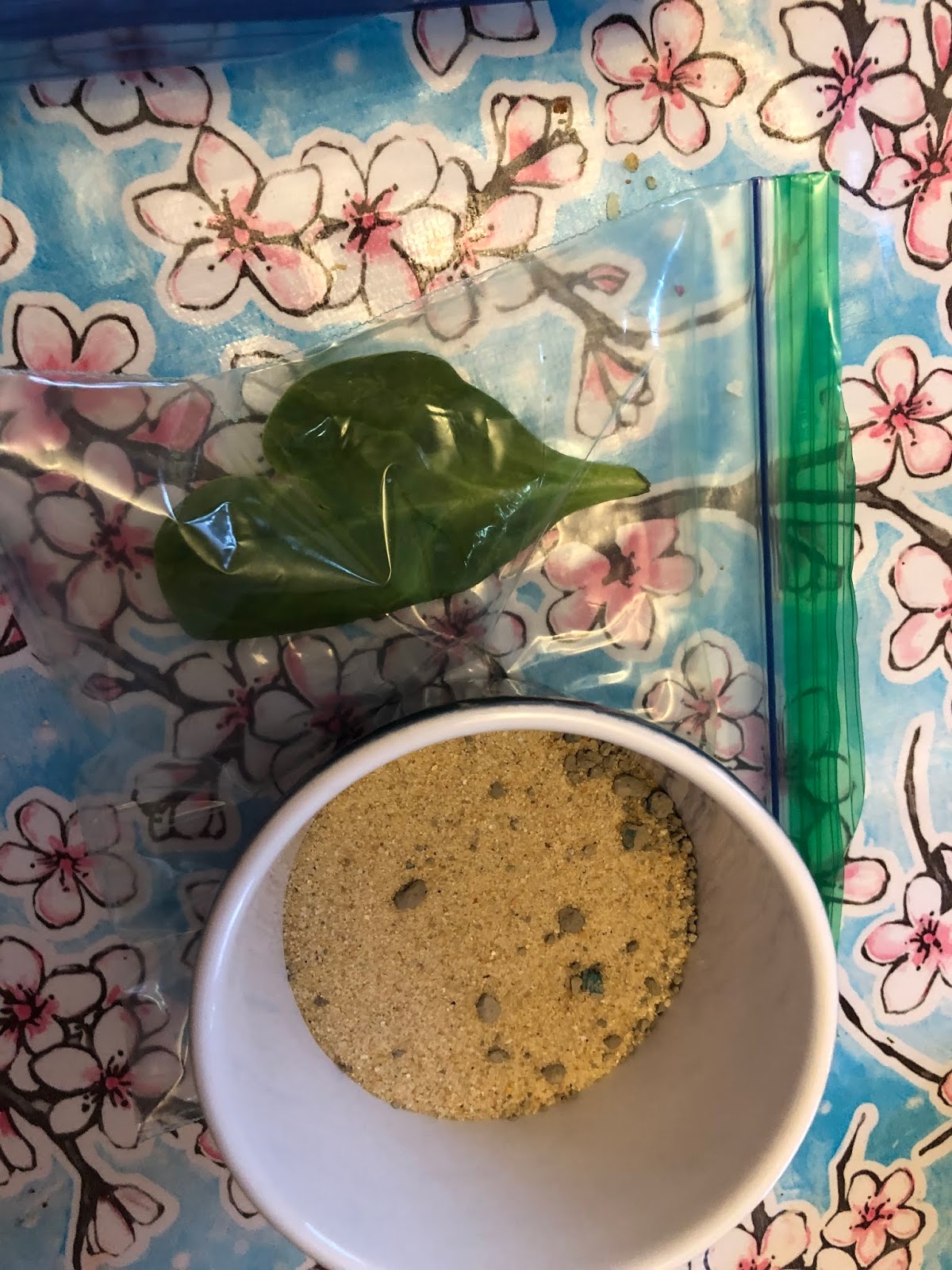
We used a sandwich bag and a spinach leaf to illustrate the problem.  The bag is like the stomach: when the kids mushed the leaf inside the bag, it hardly broke down at all.

But these dinosaurs, like some birds today, swallowed rocks (gastroliths: stomach stones) to grind the food in their stomachs.  We added a bit of bird grit (like coarse sand) and the leaves were quickly pulverized.

The fossil gift of the week was dinosaur eggshells, almost definitely from sauropods, probably from saltosaurus.

 We saved the favorites for last: theropods! T Rex, Velociraptors, Deinonychus, Spinosaurus, Allosaurus, and Archeopteryx are all in this category.

These start out as all two legged carnivores, although a few late cretaceous ones become herbivores.

Here we get the birds: all theropods have wishbones, and most of them seem to have had feathers.
Then it was time to look a bit more at how we know what we know about these animals.

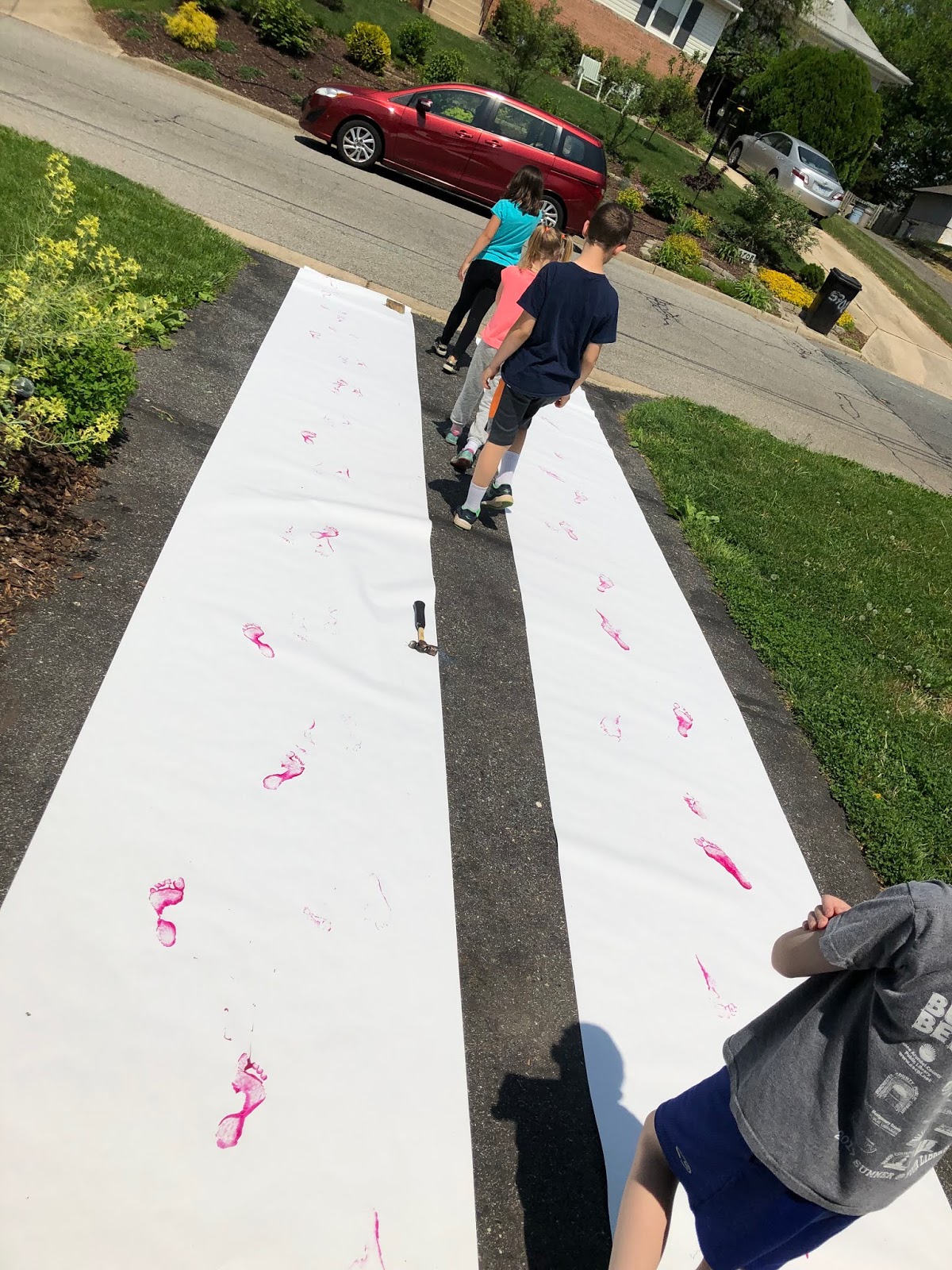
We put paint on kids' feet and had them walk, run and hop, to look at how we can tell so much about dinosaur bodies and movement from trackways and prints.

Only a few kids were actually up for getting paint on their feet, but they were all interested in the tracks!

Then it was time for my all time favorite dinosaur activity: chipping bones out of plaster.

They loved this!   I'm always amazed at how long they want to do it.

 And then the T Rexs showed up...

This may be my new favorite dinosaur activity!

I was concerned that some of the younger kids might be freaked, but they all LOVED the dino visit!

And many thanks to Zorg and friend for suiting up for science!

Tuesday, April 30, 2019

Kids' Paleontology: Dinosaurs Round 1

Four classes in and we finally hit dinosaurs!

We call the Age of the Dinosaurs the Mesozoic, and it's split into the Triassic (from the Great Dying to 225 mya), Jurrasic (ended 200 mya), and Cretaceous (ended with a bang 65 mya).

One of the key things to remember is that all the continents were connected during the Triassic, which is why we find fossils of some of the early dinosaurs on literally every continent.


By the Jurassic, Pangea had broken up into the northern super continent Laurasia and the southern super continent Gondwanaland.  That's why you only ever find tyrannosaurs in the Northern Hemisphere.

Another key thing, if you've been to the movies, is that most of the dinosaurs in Jurassic Park are from the Cretaceous.

Dinosaurs were around for hundreds of millions of years, so not all of them were around at the same time.  For example,  no T Rex ever saw a stegosaurus.  T Rexes are closer in time to eating at Taco Bell than they are to eating a stegosaurus.
Which one is the dinosaur?


So, what makes an animal a dinosaur?
It walked with it's legs under it (on land!).
It hard hard shelled eggs.
It had leathery or scaly skin (feathers are a form of scales).

There are two main divisions of dinosaurs, each of which has two subdivisions.

The two major divisions are the Bird Hips (ornithichians) and the Lizard Hips (saurichians).

This class dealt with the Bird Hips.

These are broken down into "Tank" dinosaurs  (stegosaura) like the stegosaurs and ankylosaurs, and "Beak" dinosaurs (ornithopoda), like maisaurs and triceratops.

Let's start with the main problem: yes, birds developed from dinosaurs.  We have here bird hipped, beaked dinosaurs whose name (ornithopoda) means bird footed.  These are completely unrelated to birds.  I kid you not, the birds developed from lizard hipped dinosaurs.  Evolution is funny like that sometimes...

So, tanks! These dinosaurs all had 4 legs, ate plants and were armored like, well, tanks.  Most of them had offensive weaponry in their tails, either spikes (thagomizers) or clubs.

This is a good place to mention that virtually all the common dinosaur names refer to groups of animals.  All the stegosaurs in the picture are stegosaurs, but they came in a bewildering arrray of spikes, plates, and sizes.

The beaked dinosaurs were even more diverse.  They also were plant eaters, but most of them walked on two legs.  Later versions used 4 legs again, notably the triceratops, and some could use 2 or 4 legs, rather like bears today.

These included the parasauralaphus with it's hollow crest (we used tubes of varying lengths to look at how this affected sound), all the "duck billed" hadrosaurs, the maisaurs, and the weird head-butting pachycephalosaurus.

We should point out that "beaked" dinosaurs had teeth behind those beaks, although only the most advanced late cretaceous ones could chew, something that requires a quite complicated jaw.  The kinds of teeth (in all dinosaurs) show what they ate, and, because virtually nothing can eat teeth, dinosaurs replaced teeth throughout their lives, and teeth fossilize easily, we find lots of fossil teeth!

Fortunately, all the kids had brought their teeth, and, being omnivores, had teeth good for many kinds of food.  Humans have Swiss Army Knife mouths!  We used baby carrots and our different teeth to scrape, slice, crush, and chew the carrots.

We also did our "amber" experiment.  The kids made molds out of clay, then we used colored acrylic epoxy and embedded a fern, an insect or spider, and a feather in each one.

The kids' fossil gift this class was a piece of petrified wood from the late Triassic.

Tuesday, April 23, 2019

Kids' Paleontology: Life Before Dinosaurs

 We started out talking a little more about fossil formation, particularly about why we get layers in rocks, what does and doesn't fossilize well,and why most things never get fossilized (they get recycled).

Then we went on a flying trip through the development of life, starting half a billion years back with the first multicellular creatures.

The first problem to solve when you move from one cell to many is: how will you hold yourself together?


All these creatures lived in the ocean and they were all invertebrates (no backbones).  Some of them solved this by putting a squishy membrane around themselves (which sometimes evolved into a shell),  and these were the molluscs: snails, squid, ammonites and clamlike creatures. 

Others solved the problem by putting a skeleton on their outside, a feat which allows for legs, and these were the arthropods: trilobites, sea scorpians and the like.

I started with ammonites since they had made impressions with their ammonite fossils in the last class. I showed them more classically curved ammonite shells, then pictures of weirdly twisted "heteromorph" ammonites!

I had the kids make heteromorphic shapes with pipe cleaners.

At this point, I also had kids play act the different animals as they developed, paying special attention to where they had their appendages and how they could move.  My photographer friend wasn't there,, so I don't have pictures.


 At any rate, small worm like creatures developed early spinal cords called notocords, and these developed into the first vertebrates: fish!

Some fish developed legs and managed to squelch out onto the land: amphibians!  These have their legs out to the side where fish have their fins, and their soft wet skin and eggs tie them to water.

But some amphibians developed drier scalier skin and dry leathery eggs: reptiles! I had "skinned" an
egg by soaking it in vinegar for a few days to give them the idea of the leathery reptile eggs.

Some reptiles developed into huge 15 foot long synapsids like the dimetrodon (which later developed into mammals), and some developed into tiny 15 inch saurapsids (which later developed into
dinosaurs).

Then, suddenly, 250 million years ago, almost everything died.  96% of all water creatures and 70% of all land creatures perished in what came to be called the Permian-Triassic Extinction, or "The Great Dying."  It was the worst mass extinction the planet has seen to date. 

What happened?  We know there were a lot of volcanoes that caused the Earth to warm rapidly, but also poisoned the atmosphere and water, and changed the ocean currents so that large area of water had no oxygen.  There may also have been a large asteroid strike.  Sound familiar?   It was a very similar scenario that killed off the dinosaurs, but this one was much worse and it happened before the first dinosaurs developed.

This class's fossil gift was a good sized trilobite.


Thursday, April 11, 2019

Kids' Paleontology: Fossils

This class was all about the fossils! First up was impression fossils.
 
The first kind of impression fossils are fossilized imprints of relatively flat things like feathers, leaves, or fish.  I have only a few of those: this tiny fish and some ferns.

We made our imprints on a shallow pool of plaster (on a plate) with the kids' choice of feathers, ferns, or snake skin. Spray the plaster with cooking spray before you make the impression, then leave it on for about 15 minutes.

Mold and cast fossils are, in a sense, deeper imprints.  The animal or shell gradually dissolves, leaving an impression that fills with mud turning into stone.

We have lots of examples of these, including most of our shells and all of our trilobites.

This time we used plaster in a cup impressed with real ammonites (our fossil gift for this class).

I didn't have time to do the second part of this, but, after we removed the ammonite, we had a mold left in the plaster.  We could have sprayed the mold and made another plaster cast from the mold, but we would have had to wait until the first plaster had cured enough to do that (maybe a day or so).
The third kind of impression fossil is trace fossils: leftover traces that aren't the original animal.  These include things like footprints, burrows, coprolites (fossilized droppings), eggshells, or gastroliths (stones the dinosaur swallowed to grind the plants they ate since they didn't chew).

I only have one of this kind of fossil, a rather unimpressive looking worm burrow!  But I did use toy dinosaurs to make tracks in clay.

In the picture there are 4 dinosaurs.  Can you identify which ones are dinosaurs and which traces belong to which of the 7 animals?

We also talked a bit about preserved fossils like coal, amber, and frozen wooly mammoths.

But the fossils most people think of are the mineral replaced or permineralized fossils. These include bones and teeth like this whale vertebra, dolphin jawbone, and megaladon tooth.  It also includes all the shark teeth we collect!


To show how this works, I demineralized a chicken bone by soaking it in vinegar for about a week.
 With the calcium dissolved out it gets all rubbery!

In a bone buried in soil, water leaches minerals out over time, but it also adds minerals from the surrounding soil.  This is what gives fossils their different colors, depending on what surrounds the bones, as well as they their hardness.

I also had cut out a bunch of "bones" from sponges and had the kids soak these in a solution of epsom

salts.  I showed the kids the dried salt crystals (and we talked about why it's A salt, but not THE salt), before we started.  At the next class, a week later they, were hard and white!  I had them feel a regular sponge, their "bone" sponge, and a real regular bone and a real fossilized bone.

OK, yeah, maybe I am crazy.
In case you're wondering where I'm getting all the bones, I keep a bunch of bones  from chicken, ham, beef and pork ribs, and lamb.  I clean and dry them, then store them for experiments like this.  The Zoomlians also collect (and carefully bleach) a variety of bones they've found while hiking. 

The bone collection probably sounds crazy, but it has been super useful in teaching biology, anatomy, paleontology, and any number of random wonderings.