Tuesday, April 26, 2016

3rd Grade Religious Ed: The Good Shepherd

This past weekend was Good Shepherd Sunday, and the theme was "God Blesses Contrite Hearts." Perfect!

We started out acting out the parable of the Good Shepherd with all the kids looking for our hidden sheep.

We talked about how Jesus himself was the Good Shepherd, looking for people who needed forgiveness.

If you read the Gospels, Jesus forgives a lot of people! 

We talked about three examples: Peter, the woman at Simon's house (washed Jesus' feet with her tears), and Zaccheus.  What did they all have in common?  Contrition- being sorry for what they had done wrong!

What about us? Do we do things that are wrong? Those are sins, but what is a sin? For something to be a sin, it has to have three things:

1. It has to be wrong (if it wasn't wrong, nothing bad happened)
2. You have to know it's wrong (if you didn't know, then it's a mistake)
3. You have to do it on purpose (otherwise it's an accident)

And, of course, if you want to do something wrong, but you don't do it, that's just a temptation!

We went through a lot of examples with the kids telling me if the scenarios were sins, accidents, mistakes, or temptations.

We played this board game!

Then we worked on how to do an examination of conscience.  Did you do anything wrong? Did you not do something you should have? How have you loved God and others?

 
I encouraged the kids to make a nightly Examen  where they look at what they did wrong, and ask forgiveness, but also look at good things they did (what did you do that made God smile?), and bring that as a gift to the Lord.

We did a little art project, a coloring page of the Good shepherd where we clued bits of cotton to the lamb.

And we finished up with a "Find the Lost Sheep" card game where they were looking for the card with the sheep.


Monday, April 25, 2016

Awesome History Middle Ages: Vikings-Crusades

 The 4th session was chapters 49-51; Vikings, Castles, and Knights.

We started with the art project- body traces so that the kids could design their own armor!

Very fun!  I have them hanging on the stairs since some of my kids now wear very large life sized armor!
The active activity was castle building.  I gave them a choice of building materials, but in the end everyone wanted to build with the large cardboard bricks (presumably because you could build a castle you could step into).

And, of course, Legos.


The snack was mincemeat pie (and grape juice "wine"). 

This was the first time I had made mincemeat pie with actual  meat, but it was really tasty! I used ground beef, apples, whole ground oranges, and whatever dried fruit I had on hand (cherries, apricots, and raisins).


The 5th session was chapters 52-54: Normans- Crusades.


Our active activity was the game Going to Jerusalem (which turns out to be the original name for Musical Chairs!)

Our art activity was designing coats of arms.


Our snack was apples, cheese, and bread.

And I'm almost caught up!


Sunday, April 24, 2016

Poem of the Week: Spring

Spring
  By Gerard Manley Hopkins
Nothing is so beautiful as Spring –         
   When weeds, in wheels, shoot long and lovely and lush;         
   Thrush’s eggs look little low heavens, and thrush         
Through the echoing timber does so rinse and wring         
The ear, it strikes like lightnings to hear him sing;
   The glassy peartree leaves and blooms, they brush         
   The descending blue; that blue is all in a rush         
With richness; the racing lambs too have fair their fling.         

What is all this juice and all this joy?         
   A strain of the earth’s sweet being in the beginning
In Eden garden. – Have, get, before it cloy,         
   Before it cloud, Christ, lord, and sour with sinning,         
Innocent mind and Mayday in girl and boy,         
   Most, O maid’s child, thy choice and worthy the winning. 

HT: Poetry Foundation       

Saturday, April 23, 2016

3rd Grade Religous Ed: Holy Week and Easter

 For Holy Week, we started off reviewing how Lent had been going  for them and looking at the seeds they had planted weeks ago when we did the parable of the mustard seed. 
 
Actually, I had been bringing the plants in each week that I was
here, but this was the first time the plants were actually flowering!  I had them take them home.

Then we did the Jesse Box for Palm Sunday , Good Friday,and Easter Sunday. Kerygma fest!
 Really wonderful!

We also did the Holy Week eggs.

The kids took turns opening the eggs.  There are a lot of different versions out there, but here's mine:

1. Palm leaf (paper) for Palm Sunday.

2. 40 cents in silver coins (Judas's betrayal).
3. Eucharist (pin) Last Supper.
4. Thorn (rose twig) Crown of Thorns.
5. Whip (thread) Scourging.
6. Cross (wood) Carrying the Cross
7. Nails (square cut nails) Crucifixion
8. INRI (paper) Jesus Christ King of the Jews
9. Dice and sponge (dice beads, piece of sponge) dicing for Jesus' clothes, offering him vinegar
10. Spear (toothpick and paint) Spear
11. Rock (rock!) stone sealing the tomb
12.Empty () the tomb was empty!

No class on Easter,  on Divine Mercy Sunday I was out of town, but the next week we talked about Easter! And had testing for half the class!

This time we did Easter eggs, which were based on the Way of Light (which is an Easter practice based on the Way of the Cross).

Again, there are many ways to do this and my selection was based mainly on what I had available. :)

1. Candy (candy!) Sweet surprise of Jesus being raised
2. Tears (tear shaped gems) Mary Magdalene's tears upon not finding Jesus' body.
3. Light (LED) Jesus enlightening the disciples on the way to Emmaus.
4. Host (paper host which opens to a picture of Jesus) They recognized him in the breaking of the bread.
5. Saints (saint medals) The risen Jesus was seen by the apostles and the "saints."
6. Stole (purple ribbon) Jesus gives the power to absolve sins.
7. Hand (glove) Thomas wants to see the holes in Jesus' hands and feet!
8. Fish (pipe cleaner fish - I started out with a real dried fish, but I tried it on Choclo and he was amused but declared it the most shocking thing he had ever found in an Easter egg, so I went with the pipe cleaner) The catch of fish where Jesus cooks the apostles breakfast.
9. Rock (rock!) Jesus founds his church on Peter
10. World (bouncy ball) Jesus tells them to tell the Gospel to the whole world and baptise them in the name of the Father, the Son, and the Holy Spirit.
11. Cloud (cotton ball) Jesus ascends on a cloud
12. Holy Spirit (picture) Jesus sends the Holy Spirit at Pentecost.

We didn't have a lot of time left, but we talked about the Holy Spirit and the Trinity.  I am fond of an explanation I got from St. Patrick's Summer. 

We are each one what and one who.  What I am is a woman, who I am is Mrs. Pavlat. Some things are whats, but not whos (like a chair- we can pretend the chair is a who, but really, we know it's a what, not a who. 

Jesus and the Trinity are hard to understand because they aren't like anything else we ever run into.  Jesus, like us, is one who (He's Jesus) but, unlike us, he's two whats (God and man).  No one else is like that.  The Trinity is even harder for us to grasp because it is three whos (Father, Son, and Holy Spirit) but only one what (God).

From there we talked about the Father and the Holy Spirit sending Jesus into the world (kerygma alert!), and Jesus and the Father sending the Holy Spirit to give us this new life!

We acted out the apostles before the Holy Spirit (running away and denying Jesus) and after the Holy Spirit (telling everyone about Jesus even when it cost them their lives!).

We also looked at how to recognize the Holy Spirit in their own lives. 
  • Have you ever thought about doing something bad, but then didn't do it? That's the Holy Spirit helping you resist temptation!
  • Have you ever suddenly thought of something nice you could do for someone?  That's the Holy Spirit, too!
  • Have you ever suddenly understood something about God, like realizing it's really Jesus in Holy Communion?  That's the Holy Spirit enlightening your mind!
  • Have you ever seen a really beautiful  sunset and thought, "Wow, God is amazing?" That's also the Holy Spirit!
And then we ran out of time! :)


Friday, April 22, 2016

Masters of Disasters: Hurricanes and Tornadoes


Last week we talked about the sun, this week we talked about water.  Where do we find water?  Where does it come from?  Where is it going?  The kids had a good theoretical grasp of the water cycle, so it was time to to get practical!

Water evaporates, but it needs energy to change phase.  You can feel this if you spread a thin layer of water (or alcohol) on your forearm.  You caan feel the liquid absorb heat from your arm so that it can jump to it's vapor phase!

Next up we made a cloud from water vapor: you take an empty soda bottle and add a little hot (not boiling) water.  A few drops of alcohol will make this more dramatic.

Light, then blow out a match and put this in the bottle.  You won't be able to see the smoke, but it's there, and it's critical - water needs something to condense on.  Seal it up and squeeze the bottle a few times. Cloud!

We also made rain ( hold a pot of ice water over a pot of boiling water), and lightning (balloon rubbed against wool in a dark room - for added pizazz, catch the spark with a florescent bulb!).

 We looked at cold air falling and hot air rising by using a smoking match in front of an open freezer and over a hot stove.

Then we talked about what happens when there is a lot of hot air rising and a lot of cold air falling at the same time.  I had enough kids that I had them demonstrate it by having half the kids go up the stairs while the other half were going down the stairs.

Nature handles this the same way we handle traffic- everyone goes to one side.  It doesn't matter if it all goes left or all goes right, all that matters is that it all goes the same way!  In a natural 3 dimensional system, this means spinning- this is why hurricanes and tornadoes spin!

We looked at hurricanes by using spinning water in a big pot.  We dropped in a paperclip on a thread to see where the strongest and fastest current was (near the edges) and we talked about the storm front and the eye.

We also looked at how the wind raised higher waves in shallower water by blowing through straws across a baking pan filled with varying amounts of water.


The favorite was an example of hot air rising: tea bag rockets!

Thursday, April 21, 2016

3rd Grade Religious Ed:Spiritual Works of Mercy

Class 18 was a continuation of the Works of Mercy, but this time with the Spiritual Works.  I was absent for this class, but I planned it and the Emperor did it for me. But we're short on photos. :)

We started with a discussion of the Divine Mercy Image and the Year of Mercy.

The image shows Jesus pouring his mercy on us: the red rays symbolize his sacrifice, the blood He shed for us, and the blue rays symbolize the healing waters of baptism and grace.

This all ties back in to the kerygma!  Jesus died and rose and invites us into his new life!

Because we had done the Holy Door craft last time, we had a short video of Pope Francis opening the Holy Door in Rome.  We also had a 60 second Lego explanation of the Year of Mercy. Pretty fun!

The book theme this week was "Jesus Gives Us the Holy Spirit, " so we talked about the Holy Spirit
and the Trinity.  I'm always surprised at how few kids seem to understand that the Holy Spirit is God.

After Jesus was raised he took his glorified body back to heaven, but He promised to send us a helper: the Holy Spirit. How does He help us?  He helps us to be who God created us to be, to be holy! He speaks in our hearts and helps us act in ways that show God's love.

We call some of those ways of showing God's love the Works of Mercy.  Last time we had looked at the some of the ways we show God's love using our bodies (the Corporal Works), but we can also show God's love using our hearts (the Spiritual Works).

For the Spiritual Works, we colored and made these mini books by Look to Him and be Radiant.

Then we had the kids come up with and act out scenarios for each Spiritual Work. I had a nice list, also from Look to Him and be Radiant, in case we couldn't come up with anything.

I have to admit that I completely underestimated the time this would take, and we didn't get through all the works, but they did get to take home their mini books and the list.

Class 19 Was "We are Part of the Kingdom."  I had planned to connect the Gospel (the Prodigal Son) to the theme of mercy, specifically asking who showed mercy in that parable, have we been shown mercy in our lives, and how do we show mercy.  That would bring us back to the Works of Mercy, and I thought we could finish up the Spiritual Works.

We also were going to talk about the Communion of Saints with a special focus on Our Lady of Guadalupe... and this was where I got pneumonia, so I wasn't actually at this class either. :(

Tuesday, April 19, 2016

Masters of Disasters: Big Changes


This series is focused on the forces that shape and change our planet.  I'm using it for 8-12 year olds, but I've done it with kids as young as 5-6.

Our planet is always undergoing changes, but when big changes happen quickly, we call them disasters: hurricanes, volcanoes, earthquakes, and the like.


One big force driving changes on our planet is the sun!


Yes, I realize there is a more accurate song, but I find that with young kids, it's better to use this song, and then explain that the gas on the sun is so hot that it's actually a new form of matter called plasma (because it's electrons are stripped away).

 Understanding exactly how the sun is affecting the earth is one od those things where a demonstration is worth 1000 lectures.

I like to take the globe into a dark place and use an incandescent bulb to represent the sun.  My globe has a conveniently accurate tilt, so it's easy to walk it around the "sun" and see how the parts of the earth receive more or less light at different points in the earth's orbit.

If you use an incandescent bulb, you can also show how distance and angle affect the heat each part receives (I have them put their hand on the globe).

 Now a question:  you can see how the sun gives heat and light to the earth, but what effect does that really have?  Could that light actually move anything on the earth?

Most kids don't think so, until I show them my radiometer. It was a cloudy day, so I had to take it outside to get it really moving.

The sun is really adding energy and moving things around on our planet!

Next question: what color is the sun?

We looked with a spectrometer!  Mine is store bought, but they are easy to make. You can see all the colors the sun is giving off!

We also looked at the light through prisms and water filled jars.

The jars help you see how light is bent and scattered as it passes through the atmosphere.  Air molecules scatter more blue light (which is why the sky is blue).  Water and dust tend to scatter the light evenly, so they look white.

This is why when you look straight up, the sky looks a darker blue: you are looking straight through the atmosphere.  When you look on the horizon, it usually looks paler because you are looking at the atmosphere at an angle and are seeing more of the low hanging water and dust.  Our summers are so humid that the sky looks nearly white at the horizon! You can see a little of this by looking through the jar straight on, and then at an angle.
Next up: wind!

What makes the wind?  One small part is the rotation of the earth.  I had the kids spin around with outstretched arms to feel the breeze.
Most of our wind is from the sun heating the atmosphere.   

How much the sun will heat things up depends on many factors, including the color of the earth beneath the air.    I used my scanning thermometer to look at the temperature of the black driveway and the light sidewalk: a 10 degree difference!

As the air warms, it expands, and as it cools, it shrinks. I like to have the kids model this by having them move slowly close together, then faster, bumping off of each other and taking up more space.

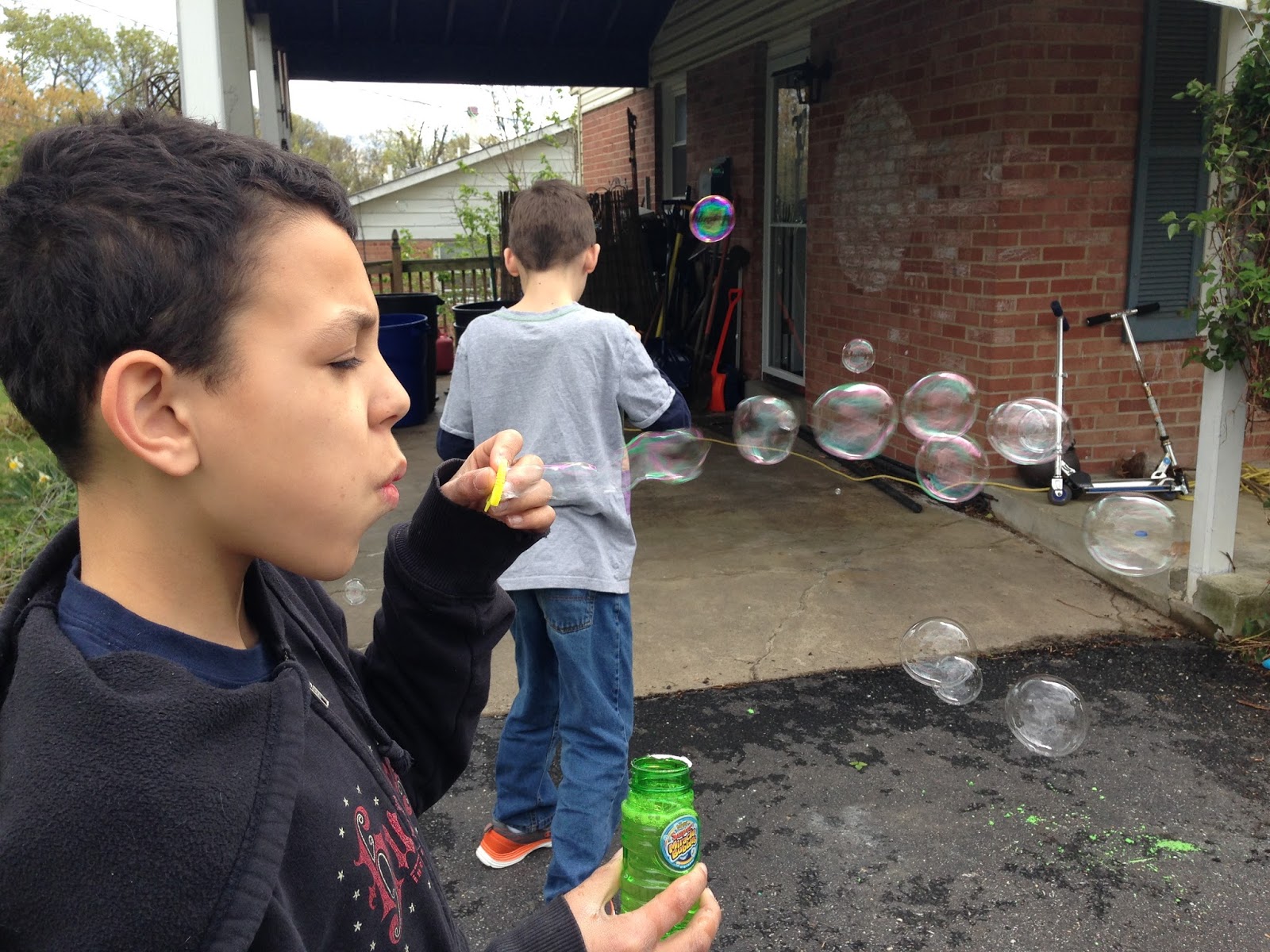
You can see this by blowing bubbles on a cold day.  Bubbles blown with your warm breath will rise, and bubbles made by the breeze from swinging your arms tend to fall.  This works best on a cold day without a lot of wind!