Showing posts sorted by relevance for query kids' astronomy. Sort by date Show all posts

Monday, September 10, 2018

Fun With Astronomy

So far this class is as much fun as I had hoped!

I have 8 high schoolers and I am cramming stuff into every minute of our two hour classes, so I haven't been able to take many pictures.


Our first class was on star gazing.  That's usually done last in most Astronomy classes, but I feel that looking up with wonder is how kids start Astronomy in real life.

It helped that we were able to go to the University of Maryland's observatory, attend a talk by an actual astronomer, get a tour, and look through their telescopes the day after the star gazing class!

We also used a celestial globe and made planispheres (adjustable star charts).

I've used planispheres, but this was my first time using a celestial globe, and it's amazing!  I had a hard time wrapping my head around it at first because all the models I've ever used were showing me how things actually are: the celestial globe shows how things look from Earth.  The little yellow ball is the sun, not the moon: remember that the sun and the moon are the same apparent size from Earth.

You wouldn't think"how things look" would be very useful, but I finally gut level understand what is happening at the equinox!  I mean, I knew that was when the ecliptic crossed the celestial equator, but I didn't really "get" it until I saw it on the celestial globe.  Also, it really is the easiest way to demonstrate seasons and the zodiac, humanity's first calendar (no astrology here!).

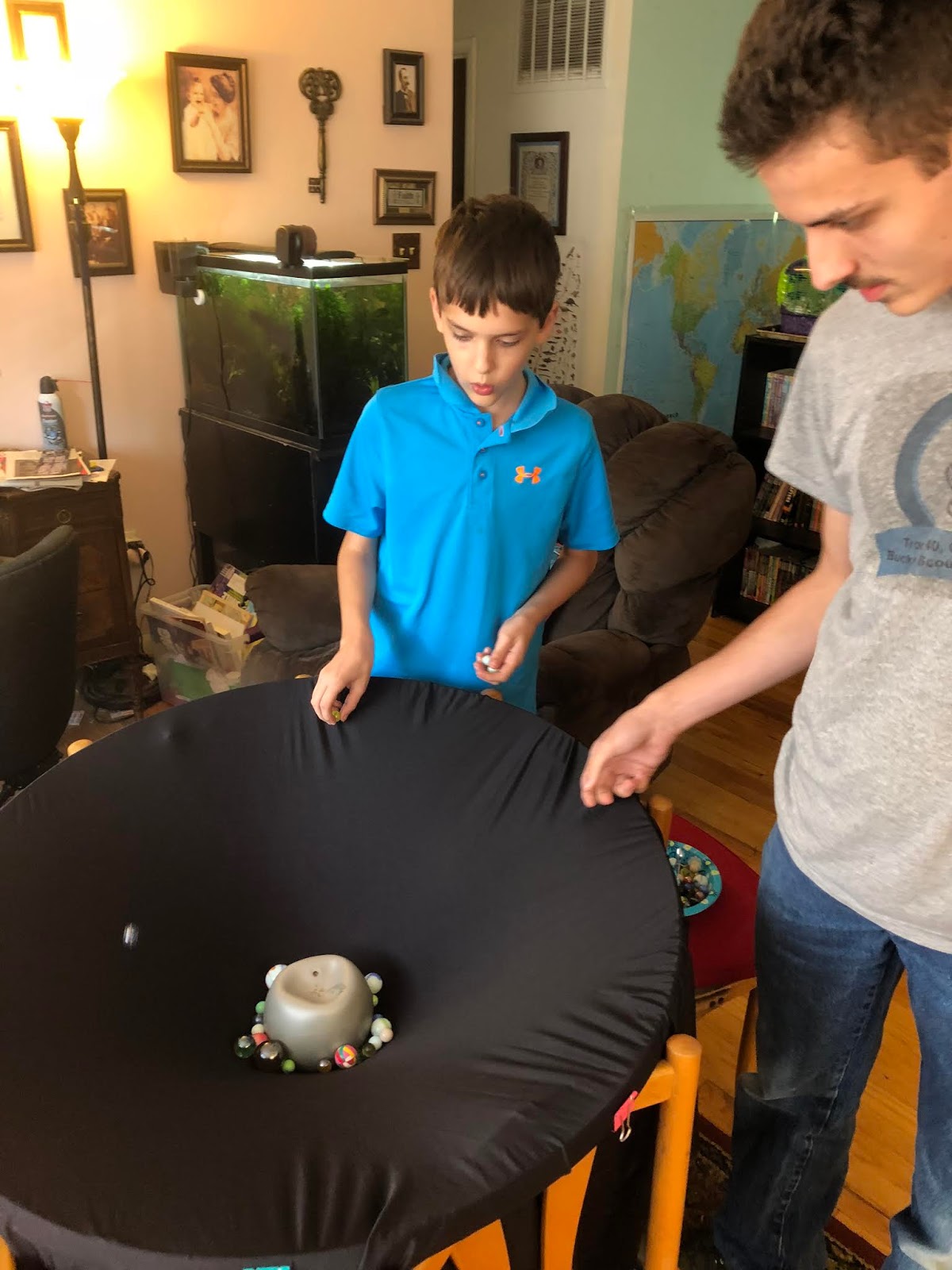
The next class was on actual stars and we did a more detailed space time model to explore gravity wells, and we did a fair bit with spectroscopes and special candles with colored flames. Lots of star cycle stuff and lots of stuff on black holes.

I've always enjoyed doing the Kids' Astronomy classes, but it's been really fun to go into it with more depth.  And the questions these kids have!  I just love it!

Today we are off to visit the planetarium down at the Air and Space Museum - hopefully I'll have pictures up on Wednesday.

Monday, March 24, 2014

Kids' Astronomy and Rocket Science: the Big Picture


 Okay, technically, it's not rocket science.  It's model rocket science.

And it's super fun!

We started our younger kids science class last Thursday.  I have 11 students aged 6 to 12 (including Oob, Choclo, and Leena) and 5 older lab assistants (including Zorg, Klenda and Mxyl, our staff photographer).  All photos will be from from Mxyl.


Here's how our class is set up:
1 Motion and Distance
2 Earth and Other Planets
3 The Moon
4 The Sun and Other Stars
(Easter Break)
5 Rockets: Newton's First Law
6 Rockets: Newton's Second Law
7 Rockets: Newton's Third Law
8 Visit Observatory (at night!)
9 Build Rockets
9.5 Optional extra build class for older kids and fancy paint jobs
10 Launch Rockets at NASA Goddard

I'm drawing a lot from Janice Van Cleave's Astronomy for Every Kid, and from the rocket program developed by my cousin, Ed (whose granddaughter is taking the class!).   I'll post all the materials and sources as I go - most of it's free, either printable on line or stuff you probably have.  The exception is the model rockets themselves.  I'm getting them in a class pack from AC Supply - way the cheapest and easiest way to do it.

Cheapest because it breaks down to $15-$20 a complete rocket (including 2 engines per rocket) counting the shipping.

 Easiest because I'm getting rockets with pre-molded fin assemblies.  If you are doing this with single digit kids, this is the way to go.  Older kids can get their own fins on straight, but with younger kids, it's an exercise in frustration..

I've now done the rocket program three or four times and I keep adding on and fiddling with it.  I blogged about the rockets last time in 2011.  This time around, each class is an hour.


Thursday, May 5, 2011

Science Astronomy

We were headed off into our Astronomy unit - our final unit of the year! But first we had to check on our crystallization experiments.

I had made up solutions of salt, sugar and epsom salts and had the kids drop them onto black paper. Alas, my paper wasn't cheap enough, so it didn't absorb the solution very well and the kids couldn't take home their papers that day. On the other hand, the crystals which eventually formed were larger and more perfect.

We looked at them with magnifying glasses.


The next experiment was with a salty solution. We divided it into two pots. One we boiled away the water causing the crystals to form quickly and rather haphazardly.

The other formed large square crystals as the water evaporated over the course of two weeks.


Lastly, I was trying for rock candy. I have never managed this well, so I tried the Joy of Cooking. I had always shunned that recipe because it asks you to boil the syrup til the hard crack stage which I had always thought would solidify like stone.

When I finally thought to check the progress, it had indeed set solid, so I did a second try with only boiling til the sugar dissolved. Unfortunately, it was less than a week so we got some crystallization, but nothing big or fancy.
Oh well! They had fun eating the crystals that did form and Oob licked up a lot of the syrup!

So we moved on to Astronomy.

I took the kids outside and had them move as much as they could and then be as still as they could.

Than I asked them if they were still moving. Trick question! The stillest thing on the planet is still spinning with the Earth at about 1000 mph!

And then we started talking about the Earth's orbit (about 67, 000 mph).

And then we talked about the Sun's orbit (486,000 mph) ... around the Milky Way! I must admit, everyone but the Zoomlians looked highly skeptical about this one.

Next we tried some orbiting. Here we have Choclo as the Sun with the other kids as the different planets (I'm glad they kicked out Pluto, I wouldn't have had enough kids!). I lined them up and then started them orbiting.

After a little while, I stopped them and asked what they had noticed. They had figured out that the closer planets make more orbits than the farther ones.

We talked a bit about what was in the solar system (sun, planets, dwarf planets, astroids, moons, comets, Kuiper belt) and what wasn't (constellations, black holes), then it was back to orbiting.

I had one kid as the sun, spinning in place and moving slowly, Klenda as the Earth orbiting the sun (I didn't have the nerve to have her spin) and Zorg as the moon, tidally locked, orbiting the Earth. This is hilarious to watch! I highly recommend it as a party game. They actually did really really well until the sun started moving too quickly!

That was it for this lesson, so the kids made up a game which was like tag except the person who was it was a black hole and all the other players were stellar objects (red giants, brown dwarfs, white dwarfs, purple and yellow dwarfs (also known as a smart aleck).

I got my favorite compliment at the end of the lesson: "That's it? That was only 5 minutes!"

Tuesday, March 25, 2014

Kids' Astronomy: Movement and Distance

We started the class in a state of high excitement: the younger kids had not been in my class before, but had heard a lot from the older siblings.  We started out outside to burn off some of that energy!

 I told the kids to move in as many ways and in as many directions as they could think of, but they had to stop moving when I yelled "Freeze!"

After a few rounds of this, I told the kids that they were still moving. They were moving 700 mph west.  The older kids figured it out, first: they were moving because the Earth was spinning.

I explained that at the equator, they would be moving 1000 mph, and I took out a globe and showed them (with clay dots) how different latitudes traveled at different speeds (and that every step you took south, increased your speed!).

But how else were they moving?  Around the sun at 19 miles per second! But the sun is also moving, spinning and orbiting the Milky Way at 514,000 mph. We had to try it!

I was the sun and the kids tried orbiting (then spinning and orbiting) me as I moved.  It was really very silly! 

And, of course, the galaxy is moving, too.  In fact, if you add up all of our movement, relative to the center of the universe, we are moving at a mind boggling 805,000 miles...per second!

To look at how everything is moving relative to everything else, I had them draw clusters of dots on balloons, then inflate the balloons.  It's a good model for how everything in the universe is moving away from everything else.

So, the first point is that we re always moving, and moving quite quickly.

The second point is that things are really far away.

I showed the kids a standard picture of the solar system, and asked them what was wrong with the picture.

The planets and sun aren't sized correctly.

They also aren't spaced correctly.

At all.

I took a 20 sided die (the size of a grape) and had one lucky kid stand on our street corner.  That was the Earth.  Another kid held a pea, and stood a foot away.  That was the moon, correctly sized and spaced.  The sun, in this scale, is a 6 foot sphere.  I have a son who is 6 feet tall (but not wide), so Mxyl was our sun!  But where would he be, if the earth was grape sized?

This is the picture he took from the correct distance, a tenth of a mile away.  It was perfect!  Before he left, we set the "Earth" on the ground next to him as a size comparison.  Now we could see how small he looked away over there!

And the rest of the solar system?  At this scale, Jupiter (grapefruit sized) would be half a mile off, and Neptune (lemon sized would be 3 miles away.  The entire solar system, including the kuiper belt and the Oort cloud would take, at this scale, a jaw dropping 10,000 miles!

Which is why you rarely see an accurately scaled model of the solar system.  Although I did make one for this class: It's a black piece of construction paper with the tiniest pin prick I could make at the center.

But why are the things in the solar system moving?

Primarily, it's gravity, and gravity is a side effect of mass.  So how do you explain mass?  They need to understand volume, mass and weight.  If you don't explain volume at the same time as the others, the kids get confused between size and mass.

I have them reach as far as they can reach.  Volume is the amount of space you take up.  I put my hand in a bowl of water so they could see how my hand took up space and moved the water away. Naturally, they all wanted to try.

scale and balance
What weighs more, a pound of feathers or a pound of lead?  They have the same mass, but very different volumes!  Mass is how much stuff there is in you.   I had them jump and feel the mass of their bodies as they moved.

Then I used my primary balance to show mass another way.  As long as there was the same amount of stuff (the same mass) on both sides of the balance (in this case, baby teddy bears), it was steady.  That's the same if it's on the moon, or Jupiter, or here on Earth.  This mass of 5 equal bears will always equal the mass of 5 equal bears (about 28 grams).  Mass is measured on a balance

Weight is measured on a scale: a scale just measures how far it's pushed down.  Because gravity is relatively constant on Earth, the same amount of mass pushes down the same amount on the scale here.  But it would push down more on a larger planet, and less on a smaller one.

Just like the more magnets you have, the more magnetic pull you have (I used a bunch of magnets), the more mass you have, the more gravitational pull you have.  I "pulled" a kid in, and then, since we had increased in mass, we pulled a few more in, and so on.

Then it was back outside to look at orbiting bodies.  Zorg used his foxtail ball to demonstrate that an object in orbit will move away in a straight line as soon as whatever force keeping it in orbit is released.
Lastly, we looked at the effect of friction on orbits.

We rolled two marbles around in identical cake pans with one lined with construction paper.  The one with the paper slowed faster because of the friction with the paper.  Next time, I'd line it with fabric to make a larger difference between the two.

And then it was time to go!

Friday, April 25, 2014

Kid's Astronomy: The Sun and Other Stars Part 1


 We all know that the closest star is the sun, but what is the sun's name?  It's Sol, as in the solar system!

What does our star do for us?  It provides most of the energy on the earth!  Heat and light are obvious, of course, as is solar energy, but really, almost everything is solar energy.


The energy our bodies use to stay alive comes from the sun via plants (and the animals that eat plants).

The energy in the gas that powers our cars comes from ancient plants, and so does the coal that powers our electric plants.

Even wind energy comes mostly from the heat from the sun causing changes in our atmosphere.  Really, only nuclear energy and geothermal energy create energy that does not come from the sun - even tides are partially caused by the sun!

But where does the sun get it's energy?  To answer that, we had to look at how stars are formed.  I used the kid model.

We started out with kids scattered across the yard the way dust and gas are scattered in a nebula.  As the kids moved around, whenever they touched, they stuck together.  As the clump of kids got bigger, they were able to pull more and more kids in.

To no one's surprise, as the mass of kids got larger and larger, the kids in the middle started getting more and more squished.  I took two little girls of equal size and squished them together until.. POOF!  They turned into Mxyl!!  (OK, actually, they ducked out of the way and a previously unnoticed Mxyl popped up in the huddle).

This is very much like hydrogen getting squished into helium: it not only changes size, it changes it's characteristics into a whole new element!  The interesting thing is that the mass of the girls did not equal the mass of Mxyl: where did the extra mass go?

Sure, everyone knows it now.
You've heard of  e=mc2, right?  That extra tiny bit of mass is released as energy.  Energy that is equal to that tiny mass, times the speed of light squared.  Everyone knows that.

Except most people don't realize that when you square the speed of light, that number is fantastically high - like 35 billion!  A little mass makes a lot of energy!

And the sun actually converts 4 million tons of it's own mass into energy every second!


We only receive a tiny fraction of that energy here on earth, of course.  And we don't have to worry about the sun losing too much mass, either.
 We are in the sun's main sequence, the main part of a star's life which it spends fusing hydrogen into helium.  The sun has been doing this for 4.5 billion years, and is expected to continue for another 5.4 billion years.

After that, the hydrogen will be used up, and the sun will fuse helium into carbon and oxygen.  I asked the older kids: carbon and oxygen, where have we heard that before?

Us!  We're made out of stars!  Yep.

Now the sun, while fusing helium, will expand into a red giant, and by "expand" we mean it's size will encompass earth's current orbit.  (Not to worry, humans will be gone from the planet one way or another by then!)

 Then the sun will throw off a great deal of it's mass into a planetary nebula.  The rest will remain as a white dwarf until it burns out.

That's all because the sun is a small star. If it were a BIG star, that's another story!

Saturday, February 24, 2018

Seven Quick Takes: The Week it All Began

 1. I know Lent started last week, but this week felt like Lent was really underway.  I am loving the conjunction of Ash Wednesday and Valentine's Day!  For me, this Lent is all about seeing how God loves me, and how I can better love Him.  That started on Ash Wednesday when he sent me these beautiful little crocuses, springing up all over my yard!

 2. We had our first Gospel Dessert on the first Sunday of Lent.  The Gospel was Mark's super short description of Jesus in the desert: he went, he was hungry, he was tempted, the angels ministered to him.

Alrighty then!  We did an angel food cake with clouds of whipped cream and rainbows as a nod to the first and second readings with the covenant of Noah.

The Zoomlians were remarkably enthusiastic since they hadn't had dessert in... 4 or 5 days.

3. My younger kids' science class, Kids' Astronomy started!

This isn't exactly a picture of that, this is a picture of the same class I did 4 years ago when I still remembered to get pictures. 

The kids just drew dots on an empty balloon and then inflated it to simulate the expansion of the universe (everything is moving away from everything else in at least three dimensions).

And then used their balloons to make funny noises because, why not?

4.  We went straight from snow and ice on Sunday to 80 degrees and wading on Wednesday.  Fortunately, the class was on Tuesday when it was a delightful 75 degrees and breezy.

This was super nice since this is the one class (besides the rocket launch) that must be done outside.  We do a scale model of the solar system where the Earth is a grape and the sun is my son (Zorg, about 6 feet tall) and a tenth of a mile away.

If you're curious, Jupiter is a grapefruit half a mile away, and Neptune, the last of the true planets is 3 miles away. But on this scale, the entire solar system, Kuiper belt, Oort cloud and all is 10,000 miles across!  For us that stretches from Hawaii to our west to Italy in the east. Space is big.

5.  I also had my portfolio review last Wednesday, so we officially closed the fall semester.  This was delayed from the usual January because of my TIA.  Unfortunately, the combination of the odd timing and the 80 degree day made it feel like the close of the spring semester, so now I feel like school is over.  It's a problem.


6. Klenda trimmed quite a bit off her hair (don't worry, I didn't leave her half done!), which made it all wavy again. Sort of a fresh start to almost spring. Very pretty!


 7. We also started up Awesome History again!  We are on the third of three for Awesome American History and I just love it!

This is something I've been doing with a couple of very creative and very fun friends (and their kids) on Friday mornings.  We all read a few chapters separately, then we come together to do an art activity, an active activity, and a snack based on what we read. 

This week we read about the Itidarod and made these neat husky faces (among other things).

But it's also become a fun social time for moms as well as kids, and a great way to wrap up a week with a lot of fun, support, and laughter.

Here's hoping you have a great weekend, more fun with Kelly!

Monday, April 23, 2018

Kids' Astronomy: the Moon

 Just a few pictures from from our class on the moon.

I mean, we weren't actually on the moon, but, you get the idea!

Moon crater experiment: dropping rocks onto flour dusted with cocoa.
 Explaining tides: the round blue pot holder is the Earth, the black rope is the water.

Explaining moon phases with a ball of yarn stuck on a knitting needle.

 Drawing moon phases.

I love how into this kids get!


We also did the moon jump.  You mark how far the kids jump, then multiply it by 6 and mark again how far their jump would carry them on the moon!

The full class is here.

Tuesday, April 15, 2014

Kids' Astronomy: The Moon

We started out outside, asking questions: what is the moon?  Lots of great answers from the kids: everybody knew about the moon.

All right then, what's it's name?  Ummmm... "The Moon."

Except that's not the moon's name.  It's really called Luna.  I explained that, many years ago, people thought that if you slept in the light of a full moon, you would become a...lunatic!

We played a few rounds of "Full Moon, New Moon," a completely made up game in which they acted calm and reasonable when I said "New Moon," and like lunatics when I called, "Full Moon."

Then I asked them to draw the shape of the moon with sidewalk chalk.  I got a pleasing variety of moon like shapes from the traditional crescent, to circular full.  I explained that they were all correct, and we went in to the basement to see how the moon appeared to change shape.

Before I jumped into the phases, however, I did a skit.  Who Has Moons?  I played the nosy investigating reporter, and my lab assistants portrayed the planets.

Me: So, got any moons?

Mercury: Nope, too close to the sun.

Venus: Not me, I'm too close to the sun.

Earth: Sure, I've got a big one!

Me: What!  You shouldn't have a moon!  You're too close to the sun!  I'll get back to you.

Mars: I've got two moons.

Me: You shouldn't have any either - you're too close to the sun... Wait a minute, you've got little lumpy potato  moons... they look like asteroids!  You stole these from the asteroid belt!  Admit it! 

Mars: Well, they're my moons now!

Jupiter: Oh, I've got dozens of moons: more than 60.  Too many to bother counting, really...

In fact, all the gas giants have dozens of moons.  That's because they aren't too close to the sun - their own gravity was enough to form the moons along with the planet.  So, why does the Earth have a moon?

The favorite theory is that a planet the size of Mars collided with the Earth, early enough in the formation of the solar system that the Earth was still molten.

Enough combined material from Earth and the other planet (Theia) was thrown off that it coalesced into the moon.

On to the moon phases!  I've done this many times before, but this was the best model I've used: the "moon" was a ball of pale yellow yarn with a knitting needle stuck through so that it could be held without obscuring any of the phases.

I used a flashlight aimed directly at the ball as the sun.  I had the kids (in small groups stand in the middle as the Earth, and look at the ball as it traveled around them. Moon phases!

When it was in front of the sun, they couldn't see any of the ball lit up: new moon.  When it was behind the Earth, the entire ball was lit up: full moon.  In the in between places, they  saw the rest of the phases moving from new to full and back to new.

While we were at it, I showed them the lunar and solar eclipses on one of my lab assistants!  You could see the shadow of our "moon" on his shirt as it passed in front of the flash light, and you could see the "moon" pass into his shadow for the lunar eclipse.

Then we went outside to look at the sun (cast through a pin hole and projected on white paper, the best way to see an eclipse).
Naturally, the sun appeared as a round dot, and it's easy to think that is because the pin hole was round.

Then I showed them some photographs taken during an eclipse in Madrid.  What you are seeing is the dappled light through a tree.  But all the dapples are eclipsed!

We talked about tides next.  I have been looking for a good model of how tides work, and this is an adaptation of Explain-It's tide model.

The little globe is the Earth and the clay ball is the moon.  The blue circle is the Earth's water (actually some stretched out lanyard plastic rope).  You could use a file sized rubber band, but it helps to have some stiffness - plain string might be tricky.

You move the moon around, pulling on the water, showing that some of the water stays in a bulge behind the Earth, shielded from the moon's pull. The two bulges (one towards the moon and one behind the Earth) are the high tides,  The narrower places to the sides are the low tides.

You can also show how, if the sun and moon line up, you get higher tides, and when the sun is pulling on the lower narrower sides, you get lower (neap)tides.

Next we talked about why we liked the moon (beauty, tides, light at night, made of cheese, etc.).  You know someone had to say it was made of cheese.

But, did you know that the moon is white for the same reason cheese is (more or less) white? Calcium compounds.


I told the kids that I like the moon because it's slowing down the earth- otherwise our day would be 6 hours and we would have very different weather from the faster spin!

I also like it because it stabilizes the tilt of our axis so we have milder, more stable seasons.

And, of course, it does take at least some of the meteors that would have hit Earth.

We did a crater experiment, dropping rocks into two inches of flour covered with a dusting of coca powder.

They tried different sizes of rocks, and dropping them from different distances.  The lab assistants got to try dropping several at once in a "meteor storm!"
Lastly, we talked about what it was like on the moon: cold/hot, rocky/dusty, airless, and, best of all, low gravity!

I had them jump as far as they could on the driveway.  Then I multiplied that distance by 6 and marked out how far they would have gone on the moon!

Our smallest jumper would have gone 24 feet!

Our largest jumper would have been past the driveway, past the street and well into the neighbor's yard - 65 feet!

A big thank you to all my flashlight-shining-little kid-carrying-ball-orbitting-planet-impersonating-rock-dropping-moon-jumping-photo-documenting lab assistants!

Tuesday, January 6, 2015

Wednesday, March 7, 2018

Mostly Wordless Wednesday: Last Week's Kids' Astronomy, Planets 1


Thanks to Shelli for taking pictures!

The original class is posted here.

I added a demonstration of how true planets clear their orbits (as opposed to dwarf planets).

I tried picking up scattered paper clips by dragging a refrigerator magnet across them (too small and weak to pick up all the clips in it's path), then using a large magnet (cleared it's entire path).

Also, I couldn't find my scanning thermometer for the heated tiles (one is covered with a thick wool blanket to mimic Venus's insulating cloud cover) , and I was using chemistry thermometers, but, at 150 F for the insulated (warmer) tile, the kids were able to briefly touch the tiles, and this made more of an impression.