Showing posts sorted by relevance for query kids' rocket science. Sort by date Show all posts

Monday, March 24, 2014

Kids' Astronomy and Rocket Science: the Big Picture


 Okay, technically, it's not rocket science.  It's model rocket science.

And it's super fun!

We started our younger kids science class last Thursday.  I have 11 students aged 6 to 12 (including Oob, Choclo, and Leena) and 5 older lab assistants (including Zorg, Klenda and Mxyl, our staff photographer).  All photos will be from from Mxyl.


Here's how our class is set up:
1 Motion and Distance
2 Earth and Other Planets
3 The Moon
4 The Sun and Other Stars
(Easter Break)
5 Rockets: Newton's First Law
6 Rockets: Newton's Second Law
7 Rockets: Newton's Third Law
8 Visit Observatory (at night!)
9 Build Rockets
9.5 Optional extra build class for older kids and fancy paint jobs
10 Launch Rockets at NASA Goddard

I'm drawing a lot from Janice Van Cleave's Astronomy for Every Kid, and from the rocket program developed by my cousin, Ed (whose granddaughter is taking the class!).   I'll post all the materials and sources as I go - most of it's free, either printable on line or stuff you probably have.  The exception is the model rockets themselves.  I'm getting them in a class pack from AC Supply - way the cheapest and easiest way to do it.

Cheapest because it breaks down to $15-$20 a complete rocket (including 2 engines per rocket) counting the shipping.

 Easiest because I'm getting rockets with pre-molded fin assemblies.  If you are doing this with single digit kids, this is the way to go.  Older kids can get their own fins on straight, but with younger kids, it's an exercise in frustration..

I've now done the rocket program three or four times and I keep adding on and fiddling with it.  I blogged about the rockets last time in 2011.  This time around, each class is an hour.


Saturday, May 3, 2014

Kid's Rocket Science: First Law of Motion

 Shifting gears from Astronomy to Physics, today's class was about Newton's First Law of Motion: a body at rest tends to stay at rest, a body in motion tends to stay in motion, unless acted upon by an outside force.

We started out defining force as a push or a pull on something (although there are forces like drag that are a little less straight forward than "push/pull").

And we defined mass again: it's how much "stuff" is in you (as opposed to volume: the amount of space you take up). So, you can see that the scale measures a force (gravity pulling down on a certain amount of mass), while the balance measures mass (this much mass over here is equal to that much mass over there).

The first half of the law is easy to demonstrate: a body at rest (a lab assistant) tends to stay at rest, unless acted upon by an outside force (alarm clock).   I also set up a model rocket and let the kids do a countdown to... nothing happening.  Without the engine to provide an outside force, it just sits there!

But there are more fun ways to show this: we gave each kid a cup, a card (to set on the cup) and a quarter (to set on the card).

When you flicked the card away, the quarter tended to stay in place until acted upon by an outside force (gravity), at which point it fell into the cup.

We also did the quarter on the elbow trick. And I used a string of rubber bands to drag a large (smooth bottomed) rock.  You can measure the force it takes to move the rock by the length of the bands.  The bands stretch a long way to get the rock moving, but then they shorten up as it continues moving.

The fancy term for the first half of Newton's First Law is inertia, while the fancy term for the second half is momentum.  Once you start looking, there are practical examples of both everywhere!

Think about how difficult starting a hula hoop versus keeping it going or balancing a still bicycle, versus a fast moving bicycle.

Let alone biking up a big hill from a standing start!


Perhaps most importantly, these laws tell you exactly why you should wear seat belts.  To demonstrate this, we played a game I'll call Train Wreck.

I had a ll the kids form a train behind me, an off we went.

After we picked up some speed, I stopped quickly.  Train wreck!

There are some other fun ways to use momentum.

 For example, eggs.  Of these 18 eggs, 6 are hard boiled.  I had the kids spin them to determine which ones were raw( how's that for bravery in the name of science?!).

If you spin a raw egg, stop it briefly (with a light touch), and let go, the liquid inside will continue to spin,and the egg will turn.

You want us to what?
A hard boiled egg will take a tiny bit more energy to stop, but it will stay stopped.

 And, of course, there's always spinning around until you get really dizzy.  That's the momentum in the fluid of your semi circular canals, incidentally.

So that's about it.  Am I missing something?
Oh, yes, the rockets!!

This week's rocket is the balloon rocket.

We ran strings between chairs for a track (2 tracks per set of chairs so they could "race.").

We clipped a section of drinking straw  and put it on the string to attach the balloons to the strings.

We blew up the balloons (without tying them off) and gave it a go!  And it totally did not work.

I had only been able to find round balloons instead of long tubulat balloons.  The round balloons can't be oriented enough along the track to make this experiment work as planned.

So they took the balloons outside and raced them in crazy patterns on the lawn, so, no harm done!

My young cousin got the brilliant idea to put a penny in the balloon.  It takes a bit of shaking, but once the penny gets going, it spins along the interior of the balloon for a long time: inertia and momentum!!

At the end, we had a bit of extra time, so we threw Oob a little early birthday party, much to everyone's satisfaction.  Balloons and cupcakes, what's not to like?

Tuesday, November 3, 2015

All Saints Party Games

Image from Billerica
I'm realizing (somewhat belatedly) that the the thing I wasn't blogging about, teaching Religious Education, is the thing I'll be kicking myself for not blogging about. 

That's because I use this blog as an extra lobe of memory so that I don't have to come up with brand new and exciting ideas every single time I teach rocket science, for example.
 
My philosophy of Religious Ed, is to make it as much not like school as possible.  I hated Religious Ed as a kid because it was just like school, except, since there were no meaningful consequences to not learning, kids learned nothing. 

For me, taught by my mom, this meant the annual agony of the teacher asking if any one knew the seven sacraments. No one knew them (except me) so that's what they taught every year.  For seven years

I know it was the 80s, but if you were trying to teach that the Faith is boring and irrelevant, it would be hard to come up with a better method.  I'm trying to make it as much not like that as possible, to make it fun and hands on, and to keep the kids completely engaged. For me, that means a lot of time planning and preparing.

Anyway, I've been teaching 3rd grade, and classes are on Sundays.  That means this year, All Saints Day landed on the day we had class. Party time!


 We did 5 games:

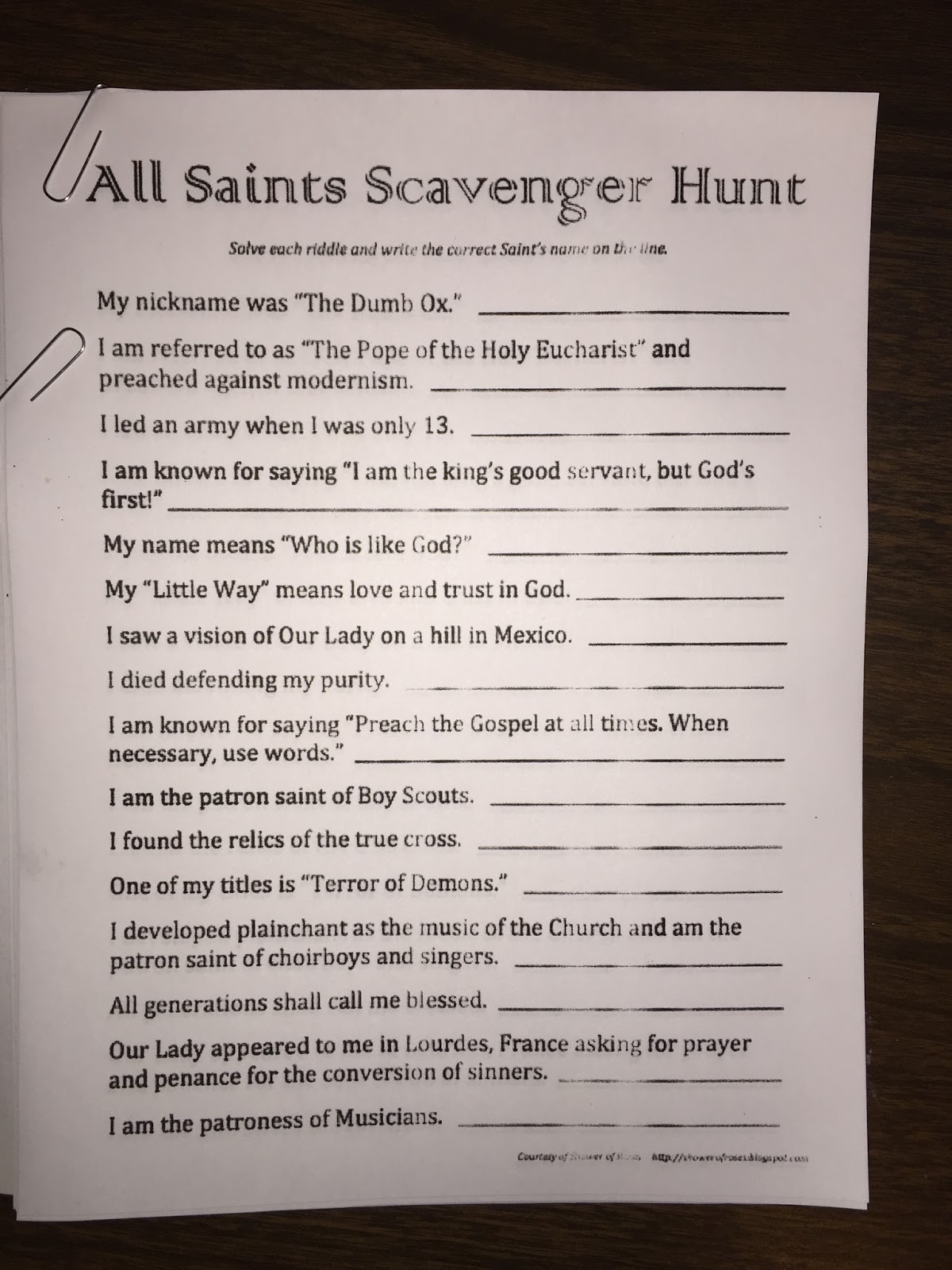
1. Saint Scavenger Hunt.  This I shamelessly cribbed from Shower of Roses, and you should print it out from her.

She, however, is dealing with home schooled kids who know much more about the Faith.  My kids had never heard of most of these saints, so I wrote on the pictures a little first person introduction which contained the answer to the clue.
For example, on Mary's picture, I wrote, "I am Jesus' mom, and I'm your mom, too.  I will always love and care for you.  God did wonderful things for me, so everyone calls me blessed."  (The clue was "All generations call me blessed.")

I have 8 kids in the class, so I gave each two pictures, and they asked each other questions.
 When they finished, they got to pick a prize out of a bag of medals and pins.

2, Halo Toss.  I was going to use different saints, but I figured that might be confusing, so I printed an extra copy of the saint pictures from the scavenger hunt, and taped them around water bottles. 

This meant there were two pictures on each bottle, but they mostly covered the bottle.  Then the kids tossed foil "halos" and tried to land on the bottles.  I told them which saints they had gotten and the prize was a holy card (printed from the internet) of their patron saint.


3. St. Anthony's Fishing.  I told them the story of St. Anthony, trying to tell people about Jesus.  When the people wouldn't listen, he started preaching to the fish.  All the fish in the river poked their heads out of the water to listen!

I double dutied here: each fish had one of the seven virtues on it, so we explained what each virtue meant as it was "caught."  Since it was "their"  virtue, they loved it.  And of course, the virtues are how to become more like God - saints!

If it isn't obvious, that's a stick with string and a magnet (in my case, folded magnetic tape), and each fish has a paperclip or two.  The idea is to make it a little hard to fish, but not impossible.


4. Little Flower Memory.  I happen to have a lot of holy cards, but you could do this with pictures from the internet.  I glued pairs of the same saint cards to index cards, then I glued a picture of St. Therese on the back of all the cards.  We talked about St. Therese's "Little Way" of doing little things with big love.

Each kid got a turn, and when they made all the matches, they got to pick a prize from my stash of Bible story stickers. 

Interestingly, a boy who picked the "Daniel in the Lion's Den" sticker set remarked that he didn't remember the story, but he'd look it up when he got home.  To me, that was a win, if he looks it up, he's much more likely to remember it than if I tell him (although I would have told him if he'd asked).

5. St. George and the Dragon.  I told the story of St. George, and how he had killed a large crocodile that had been eating people.  The people were pagan, and had started sacrificing people to the crocodile "god."  St. George killed the beast and taught the people Christianity.

The classroom has one foot tiles, so I paced off 20 feet to show the kids how big a crocodile can get and why people would see it as a dragon.

Then they took turns blowing over the "dragon" (skillfully rendered by my assistant, Klenda) with our air cannon.

Then we had chips and candy corn, and the kids replayed whichever games they wanted while waiting for parent pick up.

Wednesday, May 21, 2014

Kids' Rocket Science: Third Law of Motion


 The third law is the one everyone remembers: for every action there is an equal and opposite reaction.

The favorite demonstration of this is the Newton's Cradle.  Perfectly equal and opposite reactions!


Having done this lesson a number of times, here is my advice: yes, you need a Newton's Cradle; no, you can't make one yourself; yes, you will need a new one each time because the kids will play with it until they tangle the lines irretrievably.  The good news is that it's less than $10 counting shipping. Do not take it out of the box until just before class time.

An interesting  part of the equal and opposite law is what I think of as the "billiards corollary" because this is how professional pool sharks actually make their shots.  When a ball strikes another object, it bounces off with equal force (minus whatever was absorbed by the object) in the exact opposite direction (at the opposite angle).  Lacking a pool table, we showed  this by rolling golf balls against the wall at different angles.

It's easy to see how this law works when things are moving, but most every day encounters with it are fairly static: when you sit down on a chair, you are pushing down on the chair with your entire weight, say, 100 lbs. The chair is pushing back 100 pounds. One kid asked what happened if the chair didn't push back, the answer is that if the chair can't push back enough, it breaks and I fall on the floor, which hopefully can still push back enough!

My favorite way of looking at this law is by having two kids (of roughly equal mass) stand on skateboards and push each other.  Lacking skateboards, I had them take turns standing in our wagon and pushing against me. Of course, as hard as they pushed, they moved away!

That led to a conversation about recoil: cannons, guns, baseball bats, and so forth.

 Then it was time to make the Alka-Seltzer rockets.  When I was setting up the class, I ran a few test flights to make sure that my Alka-Seltzer tablets were still good.

The good news was that the tablets were fine.


The bad news was that some of my old film canisters (which I had successfully used for this the last four times I ran this class) were no longer holding pressure. 

 Worse news: during the actual class, all the canisters, even the ones that had worked for the tests failed.  The farthest a rocket got was 6 inches off the ground! Usually we can get 20 feet in the air!

What a disappointment.


So I decided to do some tea rockets instead! 


Not a perfect demonstration of the third law, but much more satisfying!


 And I could use the left over tea to serve the class tea and strawberries!

Tuesday, May 20, 2014

Kids' Rocket Science: Second Law of Motion

 The Second Law is probably the hardest to explain to young kids: F=ma.  Force is equal to mass times acceleration.  I like to put it as: "The heavier it is, the harder it is to push.", and "The harder you push the farther it goes."

The fact is, it's more specific than that.  If push something exactly twice as hard, it goes exactly twice as far.  If something is exactly half the mass of the first thing, it will go exactly twice as far, all other things being equal.

 We looked at this several ways.  I used a very light ball, and a sand filled ball that happened to be a similar size, and tried tossing them. This is good because it confirms their everyday understanding that, yeah, you have to use more force to throw a heavier ball. Naturally, any boys in the class will try to throw the heavy ball as far as possible, but, in my view, that's okay- they can feel the extra effort it takes to heave the extra mass.

Then we tried dropping the two balls in the sand box.  This was actually a better experiment because you could easily see the dents left behind by the two balls (the heavier ball left a deeper dent because it fell with more force, while the acceleration of gravity was constant)

We also rolled real golf balls and foam golf balls (you could use ping pong balls) down an incline and saw that the more massive balls rolled farther. Again, this is somewhat more useful than throwing because the gravitational acceleration is constant when you use gravity.

It also explains why, in the Pinewood Derby, you are not allowed to have your car weigh more (have more mass) than a certain standard.  It would be an unfair advantage because the heavier cars would always win.

Now, I did say these rules applied with all other things being equal... Such circumstances are pretty rare on Earth.  A baseball hit with twice as much force won't actually go twice as far.  Why not?  One reason is that it will have gravity pulling on it for a longer  time since it will be in the air a longer time. Another reason is that it has to travel through more air, and therefore more air resistance.

Ah, air resistance.  That's pretty important when you're talking about rockets.  How far can you throw a piece of paper?

Try throwing a plain flat sheet of paper as hard as you can.  It's pretty hilarious, actually.  One of the kids immediately suggested that we wad it up into a ball.  That went much farther, even though it was the same mass as the flat sheet.  Then I folded a sheet into a paper airplane, and that went clear across the room and pegged Zorg.  Sorry, Zorg!

 We made Puff Rockets from this printable pattern.  They are designed to have a very low mass, as well as minimal air resistance, and they go remarkably far on a puff of air (provided by you!).

You can also experiment with flying them with and without the fin assembly.  It really lets the kids discover for themselves why rockets have fins.
 Super fun!  Thank you Mxyl for the pictures!


Tuesday, January 6, 2015

Saturday, February 24, 2018

Seven Quick Takes: The Week it All Began

 1. I know Lent started last week, but this week felt like Lent was really underway.  I am loving the conjunction of Ash Wednesday and Valentine's Day!  For me, this Lent is all about seeing how God loves me, and how I can better love Him.  That started on Ash Wednesday when he sent me these beautiful little crocuses, springing up all over my yard!

 2. We had our first Gospel Dessert on the first Sunday of Lent.  The Gospel was Mark's super short description of Jesus in the desert: he went, he was hungry, he was tempted, the angels ministered to him.

Alrighty then!  We did an angel food cake with clouds of whipped cream and rainbows as a nod to the first and second readings with the covenant of Noah.

The Zoomlians were remarkably enthusiastic since they hadn't had dessert in... 4 or 5 days.

3. My younger kids' science class, Kids' Astronomy started!

This isn't exactly a picture of that, this is a picture of the same class I did 4 years ago when I still remembered to get pictures. 

The kids just drew dots on an empty balloon and then inflated it to simulate the expansion of the universe (everything is moving away from everything else in at least three dimensions).

And then used their balloons to make funny noises because, why not?

4.  We went straight from snow and ice on Sunday to 80 degrees and wading on Wednesday.  Fortunately, the class was on Tuesday when it was a delightful 75 degrees and breezy.

This was super nice since this is the one class (besides the rocket launch) that must be done outside.  We do a scale model of the solar system where the Earth is a grape and the sun is my son (Zorg, about 6 feet tall) and a tenth of a mile away.

If you're curious, Jupiter is a grapefruit half a mile away, and Neptune, the last of the true planets is 3 miles away. But on this scale, the entire solar system, Kuiper belt, Oort cloud and all is 10,000 miles across!  For us that stretches from Hawaii to our west to Italy in the east. Space is big.

5.  I also had my portfolio review last Wednesday, so we officially closed the fall semester.  This was delayed from the usual January because of my TIA.  Unfortunately, the combination of the odd timing and the 80 degree day made it feel like the close of the spring semester, so now I feel like school is over.  It's a problem.


6. Klenda trimmed quite a bit off her hair (don't worry, I didn't leave her half done!), which made it all wavy again. Sort of a fresh start to almost spring. Very pretty!


 7. We also started up Awesome History again!  We are on the third of three for Awesome American History and I just love it!

This is something I've been doing with a couple of very creative and very fun friends (and their kids) on Friday mornings.  We all read a few chapters separately, then we come together to do an art activity, an active activity, and a snack based on what we read. 

This week we read about the Itidarod and made these neat husky faces (among other things).

But it's also become a fun social time for moms as well as kids, and a great way to wrap up a week with a lot of fun, support, and laughter.

Here's hoping you have a great weekend, more fun with Kelly!

Tuesday, April 24, 2018

Rocket Science: Laws of Motion 2018

1st Law: A body at rest stays at rest, a body in motion stays in motion unless acted on by another force.

Looking at inertia with the quarter/card/jar trick.

 Looking at mass with scales and balances (and jelly beans!).

We also looked at momentum with raw and hard boiled eggs.

And we made balloon rockets.

Full  1st Law class here.

 2nd Law of Motion: F=ma, force equals mass times acceleration.

It takes twice as much force to move twice as much mass, or half as much force to move half as much mass.

We looked at this by dropping a heavy marble and a light foil ball into flour.  They hit at the same time, but the heavy ball made a big crater, and the light one barely sunk in.

We did a few other demonstrations including a race of a heavier and lighter car down a ramp.

And we made puff rockets!

Full 2nd law class here.
3rd Law: Every reaction has an equal and opposite reaction.

Gotta love a Newton's Cradle!

We also did the thing where the kids stand in a wagon and push on me.

And the billiard ball thing with angles.

And Alka-Seltzer rockets!

Which worked this time since I had bought new film canisters.  It was still pretty random: some popped up 15 feet in the air or more, but many only popped up a couple of feet.  We got the best results with half a tablet and just enough water to cover it.

Full 3rd Law class here.


 Lots of science fun!


Next week, we'll build and paint our model rockets, and the following Sunday we'll launch them at NASA Goddard!